As CNC woodworking continues to dominate cabinet manufacturing, furniture production, and panel processing in 2025, choosing the correct spiral direction (flute geometry) has become a critical factor. Chip evacuation, edge quality, heat control, and tool life all depend on one decision:
Should you use an Upcut, Downcut, or Compression bit?
This guide breaks down the engineering logic, real factory experience, and material-specific recommendations professionals use to achieve clean, efficient, and consistent results.
Why Spiral Direction Matters
Flute direction directly affects:
- Chip evacuation
- Tear-out on the top or bottom surface
- Heat dissipation
- Dimensional accuracy
- Tool wear rate
- Overall surface quality
Choosing the wrong bit often results in:
- Burn marks
- Chipping and fuzzy edges
- Poor finish on laminated materials
- Excessive heat and premature tool failure
Understanding spiral geometry is essential for modern CNC woodworking.
What Is an Upcut Bit?
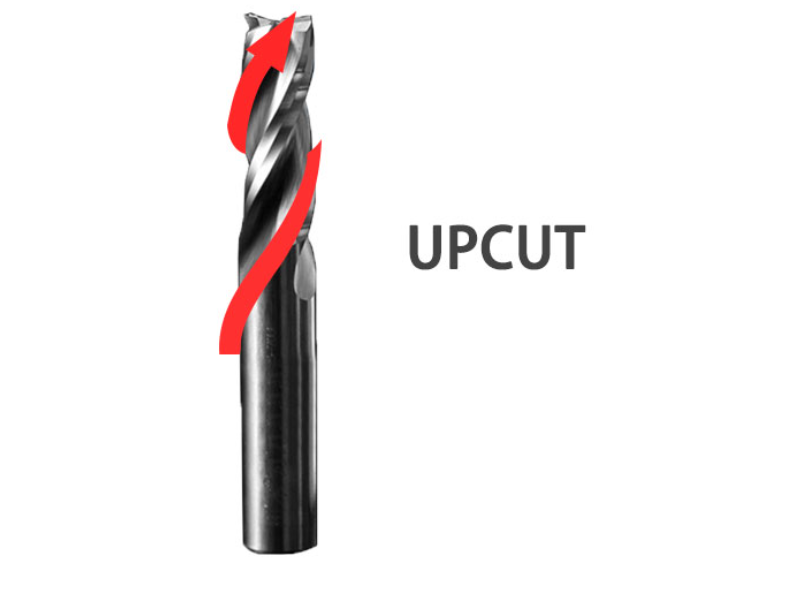
An Upcut bit features spiral flutes that pull chips upward toward the spindle.
Advantages
- ★★★★★ Best chip evacuation
- Excellent for deep passes
- Cool cutting → longer tool life
- Ideal for aggressive roughing
- Strong performance on softwood, plastics, and aluminum
Disadvantages
- Top-surface tear-out
- Needs strong vacuum hold-down
- Not suitable for laminated panels
Best Applications
- Deep slotting
- Pocketing
- Roughing cuts
- Thick hardwood
- Plastics / acrylic (polished flute recommended)
Use an Upcut bit when cutting efficiency, heat control, and deep material removal are your priorities.
What Is a Downcut Bit?
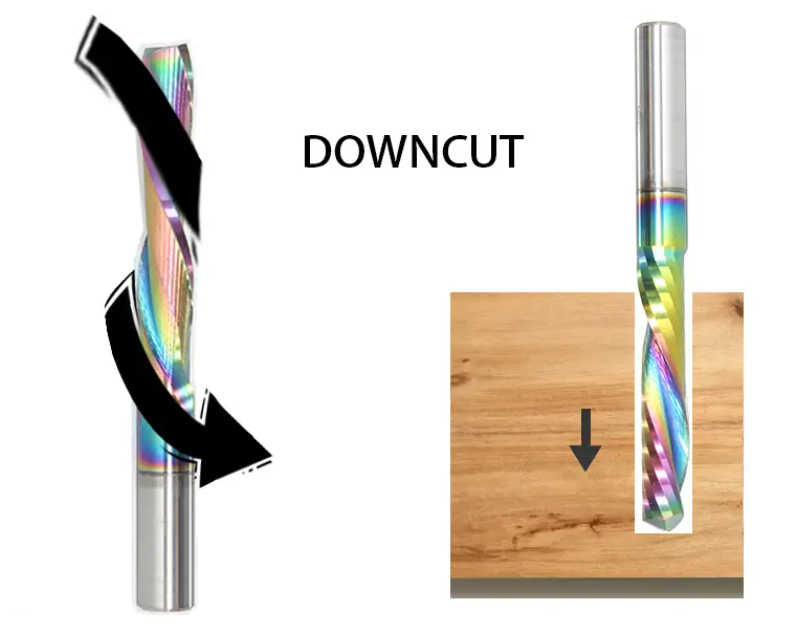
A Downcut bit pushes chips downward, compressing fibers to create a perfectly clean top surface.
Advantages
- ★★★★★ Cleanest top-surface finish
- No top-side chipping
- Ideal for shallow cuts and decorative grooves
Disadvantages
- Limited chip evacuation
- Heat buildup → burning risk
- Not suitable for deep cuts
Best Applications
- Visible top-surface machining
- Shallow grooves
- Veneered plywood trimming
- Laminate finishing
Choose a Downcut bit when top-side quality is the most important factor.
What Is a Compression Bit?

A Compression bit combines both flute types:
- Downcut flutes on top → clean top
- Upcut flutes on bottom → clean bottom
This forms a neutral compression zone, delivering perfect results on both faces.
Advantages
- ★★★★★ Zero tear-out on both sides
- Industry standard for plywood and melamine
- Suitable for high-feed CNC routing
- Increased yield in cabinet and furniture production
Disadvantages
- Higher cost
- Requires correct cutting depth
- Not ideal for shallow cuts
Best Applications
- Melamine panels
- Laminated plywood
- MDF / HDF
- Cabinet and furniture panel production
A Compression bit is the 2025 industrial standard for clean, chip-free panel machining.
Upcut vs Downcut vs Compression: Full 2025 Comparison
| Feature | Upcut | Downcut | Compression |
|---|---|---|---|
| Chip evacuation | ★★★★★ | ★★☆☆☆ | ★★★★☆ |
| Top surface finish | ★☆☆☆☆ | ★★★★★ | ★★★★★ |
| Bottom surface finish | ★★★★★ | ★☆☆☆☆ | ★★★★★ |
| Heat control | ★★★★★ | ★★☆☆☆ | ★★★★☆ |
| Deep cuts | Excellent | Poor | Good |
| Laminated board cutting | Poor | Good | Excellent |
| Hardwood | Good | Good | Excellent |
| CNC routing | Excellent | Moderate | Excellent |
How to Choose the Right Bit (Practical CNC Framework)
Step 1 — Identify Your Material
| Material | Best Bit |
|---|---|
| Softwood | Upcut |
| Hardwood | Compression / Upcut |
| MDF / HDF | Compression |
| Plywood | Compression |
| Melamine / laminate | Compression |
| Plastics / acrylic | Upcut (polished flute) |
Step 2 — Identify Surface Priority
- Clean top → Downcut / Compression
- Clean bottom → Upcut / Compression
- Clean on both sides → Compression
Step 3 — Consider Pass Depth
- Shallow pass → Downcut
- Deep pass → Upcut
- Full-sheet cutting → Compression
Step 4 — Consider Production Speed
- High feed speed → Upcut / Compression
- Slow, precision cutting → Downcut
Step 5 — Machine Type
| Machine | Suggested Bit |
|---|---|
| Hand router | Upcut / Downcut |
| CNC router | Compression / Upcut |
Feed & Speed Guidelines for 2025
Upcut Bits
- Feed: 5–10 m/min
- RPM: 16,000–22,000
- Cutting depth: 1–2× diameter
Downcut Bits
- Feed: 3–6 m/min
- RPM: 18,000–22,000
- Cutting depth: <1× diameter
Compression Bits
- Feed: 6–12 m/min
- RPM: 16,000–20,000
- Cutting depth: Full sheet when possible
Tuning depends on:
- Material density
- CNC rigidity
- Vacuum table strength
- Tool coating
Industrial Applications & Case Studies
Cabinet Manufacturing
- Material: 18 mm melamine
- Tool: Compression bit
- Result: Zero tear-out, 20–30% higher yield
Solid Wood Joinery
- Material: Oak
- Tool: Upcut bit
- Result: Deep pockets with stable chip evacuation
High-End Furniture Panels
- Material: Veneered plywood
- Tool: Downcut bit
- Result: Perfect top finish with no chipping
ZC-TOOLS Professional Cutting Solutions
For workshops requiring:
- High feed rates
- Chip-free laminated panel cutting
- Stable, long-lasting tool life
- Solid carbide Upcut bits for deep roughing
- Downcut bits for ultra-clean top surfaces
- Industrial-grade Compression bits for melamine, plywood, and composite materials
Engineered for consistent performance in high-speed CNC routing environments.
FAQ
Q1: Are Compression bits always the best?
No. They only work properly when the Downcut section engages the material. Not suitable for shallow passes.
Q2: Why does my Downcut bit burn the wood?
Because chips cannot escape → heat builds up → friction increases.
Q3: Why does plywood tear out?
Plywood grains alternate direction. A Compression bit eliminates upward and downward tear-out simultaneously.
Conclusion
Each bit has a specific purpose:
- Compression bit → Best for plywood, melamine, and laminated materials
- Upcut bit → Best for deep cuts and roughing
- Downcut bit → Best for clean top surfaces
Choosing the correct flute direction dramatically improves cutting quality, extends tool life, and boosts production efficiency.