The differences in geometry and metallurgy between wood drill bits and metal drill bits determine their performance in different cutting scenarios.
From the centering tip at the point to the width of the flutes, every aspect of their design is tailored to handle the physical properties of specific materials.
By examining brad points and cutting angles like 118° and 135°, this article will take you through the industrial design philosophy behind drill bits and explore how modern coating technologies further enhance their cutting capabilities.
What is a wood drill bit?
A wood drill bit is a cutting tool specifically designed for drilling holes in wood, particleboard, or plywood. Its most distinctive feature is the sharp brad point at the tip. This small center point penetrates the wood surface first, preventing the bit from slipping during drilling and ensuring precise hole placement.

What is a Metal drill bit?
Metal drill bits are mainly used for drilling steel, iron, aluminum, or stainless steel components. The most common type is the twist drill bit.
The most obvious difference compared to wood drill bits is that metal drill bits do not have a brad point at the tip. Instead, they feature a conical point design. The cutting edge angle is typically ground to 118° or 135°, which allows the force to be distributed more evenly when drilling hard materials, enabling the bit to cut steadily through metal surfaces.
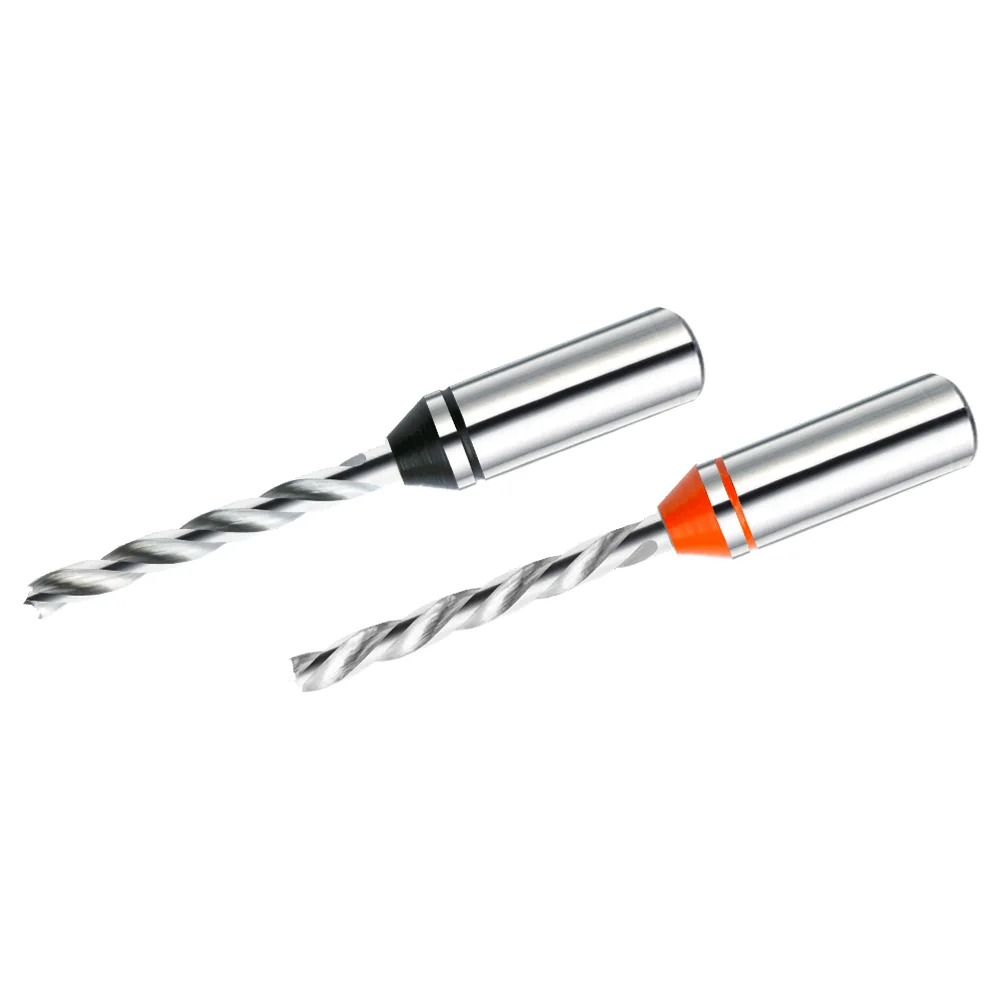
Three-Flute Woodworking Drill Bit
Understanding the Key Differences Between Wood and Metal Drill Bits
Wood drill bits and metal drill bits may look similar at first glance, but they are designed with completely different purposes in mind.
The main differences between these two types of drill bits can be seen in three key areas: the shape of the tip, the width of the flutes, and the material properties of the drill bit itself.
1. Tip Design (The Most Obvious Identifier)
Wood Drill Bits:
Usually feature a sharp brad point (centering pin) at the tip. This point bites into the wood at the start of drilling, preventing the bit from “walking” or slipping across the surface. Many wood drill bits also have spurs on the outer edges, which slice wood fibers cleanly for smoother, tear-free holes.
Metal Drill Bits:
Use a conical point or split-point tip design, typically ground at 118° or 135°. They do not have a protruding centering point. Instead, they rely on angled cutting edges to gradually cut and grind through hard metal surfaces.
2. Flutes and Chip Removal
Wood Drill Bits:
Have wider and deeper flutes. Wood produces large, fibrous shavings that must be cleared quickly. If chips are not removed efficiently, friction builds up, which can cause burning or scorching of the wood.
Metal Drill Bits:
Feature narrower and shallower flutes. Metal drilling creates small chips or tight spirals. Compact flutes help maintain the structural strength of the bit, allowing it to withstand the higher torque and pressure required for metal drilling.
3. Material and Coating
Wood Drill Bits:
Commonly made from carbon steel or standard high-speed steel (HSS). Since wood is relatively soft, extreme heat resistance is not a primary requirement.
Metal Drill Bits:
Designed for hardness and heat resistance. They are typically made from HSS, cobalt-alloy steel (often recognizable by a dull gold or bronze color), or coated with titanium nitride (TiN) to improve durability and extend tool life.
| Feature | Wood Drill Bit | Metal Drill Bit |
| Appearance | Sharp centering point at the tip | Smooth, angled conical tip |
| Function | Precise positioning; prevents splintering | High heat resistance; cuts hard materials |
| Cross-use | Never use on metal (will ruin the tip) | Can be used on wood, but may leave burrs |
Material and Design of Wood Drill Bits
From design to material selection, wood drill bits are specifically engineered to handle the unique characteristics of wood—namely, its tendency for fibers to tear and its susceptibility to heat buildup caused by friction.
Below, let’s take a closer look at the design principles and commonly used materials of wood drill bits.
1. Core Design Features
The focus of a wood drill bit’s design is precise positioning and rapid chip removal to prevent scorching or splintering.
-
Brad Point (Centering Point):
-
Mechanism: A sharp, pointed spike at the very center of the bit.
-
Function: It pierces the wood surface before the main cutting edges engage, ensuring the bit does not “walk” or slip, allowing for extremely accurate hole placement.
-
-
Spurs (Cutting Wings):
-
Mechanism: Protruding sharp edges on the outer perimeter of the flutes.
-
Function: These score the wood fibers around the edge of the hole before the main blade lifts the material. This results in a clean, crisp hole entrance without burrs or “tear-out.”
-
-
Wide Flutes:
-
Mechanism: Compared to metal bits, wood bits have wider and deeper spiral grooves.
-
Function: Wood shavings are bulky. Large flutes act like a “conveyor belt” to eject waste quickly. If the flutes are too narrow, the shavings clog, causing friction that can char the wood or ruin the bit’s temper.
-
2. Common Materials
While wood is softer than metal, different materials are used depending on whether you are drilling softwoods, hardwoods, or engineered boards:
-
Carbon Steel:
-
Characteristics: Affordable and easy to sharpen.
-
Application: Best for DIYers working with softwoods (like pine). It loses its hardness quickly if it gets too hot.
-
-
Chrome Vanadium (Cr-V) Steel:
-
Characteristics: Better toughness and wear resistance than standard carbon steel.
-
Application: A common material for professional-grade wood bits used on most natural timbers.
-
-
High-Speed Steel (HSS):
-
Characteristics: Excellent hardness and heat resistance.
-
Application: Essential for hardwoods (like oak or maple) and engineered panels (MDF, particle board). The resins and glues in man-made boards are very abrasive and will quickly dull non-HSS bits.
-
-
Carbide Tipped (TCT):
-
Characteristics: Extremely hard and stays sharp for a very long time.
-
Application: Often found on high-end Forstner bits or industrial boring bits. Ideal for high-volume production and drilling dense composite materials.
-
3. Summary
-
Design: Follows the logic of “locate first, score second, and cut third,” while maintaining “maximum clearance for waste.”
-
Material: Ranges from Carbon Steel to Carbide, depending on the hardness of the wood and the presence of abrasive glues.
Material and Design of Metal Drill Bits
Metal drill bits are typically made from high-speed steel (HSS) or cobalt-alloy steel, primarily to withstand the high temperatures generated when drilling metal. Their tips are ground into a 118° or 135° conical shape, combined with tightly wound spiral flutes. This design allows the bit to endure the significant cutting pressure required when drilling hard metals.
Choosing the Right Drill Bit for Woodworking Projects
When choosing the right drill bit for a woodworking project, you first need to determine whether your priority is hole accuracy, depth, or drilling speed, as different bits are designed with different strengths. For most fine furniture work, the brad point bit is the top choice because its sharp tip allows precise positioning and cleanly cuts the wood fibers, preventing splintered edges.
If you need to drill larger round holes in wood, such as for installing concealed hinges or creating flat-bottomed recesses, the Forstner bit is ideal due to its exceptional flatness and clean edge quality.
For electrical or plumbing work, or when drilling through thick timber, the auger bit excels with its large spiral design, quickly clearing wood chips and preventing the bit from jamming.
For rough, structural holes, the spade bit, though less precise and not as clean, is inexpensive and highly efficient, allowing you to complete tasks quickly.
Comparison of Common Woodworking Drill Bits
| Drill Bit Type | Best Use | Pros | Cons |
| Brad Point | General fine woodworking | Precise positioning, clean holes | Not ideal for very large diameters |
| Forstner | Shallow, flat-bottom, or hinge holes | Extremely smooth walls, flat base | Expensive, slow heat dissipation |
| Auger | Deep holes, thick lumber | Rapid chip removal, self-feeding | Can cause heavy “blow-out” at exit |
| Spade | Fast rough-ins, utility work | Very fast and inexpensive | Low precision, rough edges |
| Countersink | Recessing screw heads | Drills pilot and sink in one step | Size-specific to the screw |
Pro-Tips for Selection
-
Hardwood vs. Softwood: When working with hardwoods like oak or maple, always opt for High-Speed Steel (HSS) to prevent the bit from overheating and losing its temper.
-
Preventing Blow-out: To avoid splintering the back of your workpiece, clamp a piece of scrap wood underneath, or flip the board over to finish the hole from the other side once the centering point just breaks through.
-
Clearing Chips: Regardless of the bit type, develop the habit of “pecking”—withdrawing the bit periodically while drilling deep holes—to clear waste and prevent friction from charring the wood.
How to Maintain Your Wood Drill Bits for Long-Lasting Performance?
To keep your wood drill bits durable and performing well, the most important habit is to clean out the wood chips and resin from the flutes immediately after use. Once these residues harden from heat, they increase friction during the next drilling session, causing the bit to overheat and making it more prone to rust.
When storing your bits, choose a dry place and ideally keep them neatly in a dedicated storage case to prevent the tips and cutting edges from bumping into each other and getting damaged. If a bit becomes dull, use a fine diamond file to sharpen it by hand—this makes drilling easier and reduces strain on the motor.
Additionally, when drilling, periodically withdraw the bit to help clear chips and cool it down. This prevents excessive heat from reducing the bit’s hardness and ensures longer-lasting performance.
Advances in Coating Technology: Cobalt, Titanium vs Diamond-like Carbon (DLC)
In modern drill bit technology, cobalt, titanium, and diamond-like carbon (DLC) are three common advanced solutions. They mainly improve the hardness and heat resistance of the drill bit surface, allowing for higher efficiency during work.
Cobalt isn’t a surface coating; it’s an alloy element directly added into the steel. This allows the bit to maintain its hardness when drilling high-temperature materials like stainless steel, preventing the cutting edge from softening.
Titanium coatings are the most widely used today. For example, the familiar gold-colored titanium nitride (TiN) makes the surface more wear-resistant and smoother, while more advanced aluminum titanium nitride (AlTiN) forms a protective layer at high temperatures, making it especially suitable for high-speed dry drilling without coolant.
Diamond-like carbon (DLC) is an even more cutting-edge technology. It not only offers extremely high hardness but also has an exceptionally non-stick surface. When drilling aluminum alloys or composite materials, it prevents material from adhering to the cutting edge, ensuring a very smooth drilling experience.
Comparison of Coating Characteristics
| Feature | Cobalt Alloy | Titanium Series (TiN/TiAlN) | Diamond-like Carbon (DLC) |
|---|---|---|---|
| Primary Function | Enhances overall base heat resistance | Increases surface hardness and wear resistance | Ultra-low friction; prevents adhesion |
| Appearance | Dull gold / bronze tint | Gold (TiN) or violet-grey (TiAlN) | Dark grey or black |
| Core Advantage | Best for hard, high-strength metals | Versatile service life; high cost-performance | Best for aluminum, copper, and composites |
| Max Temperature Limit | Very high (alloy property) | Approx. 600°C – 900°C | Approx. 400°C |
FAQ
Can You Use Wood Drill Bits on Metal or Vice Versa?
Never use a wood drill bit on metal—its brad point will snap instantly the moment it hits a hard surface. Conversely, while a metal drill bit can technically drill into wood, it lacks a centering tip, so it tends to slip or wander during drilling. The resulting holes also have rough, jagged edges, making them far from clean or precise.