Anti-Chipping Boring Bits are not just cutting tools—they are guardians of high-quality furniture craftsmanship. In an era where double-sided laminated materials are widely used, a smooth and flawless hole determines not only the stability of hardware installation but also the overall premium feel of the furniture. Because surface laminates are highly prone to cracking, ordinary drill bits often become a breeding ground for defective products.
Here, we will reveal how anti-chipping boring bits maintain smooth cutting at high speeds and, through real-world case studies, demonstrate how ZC Tools leverages technological innovation to help factories achieve the perfect balance between cost and quality in a highly competitive market.
What Are Anti-Chipping Boring Bits for Double-Sided Melamine?
Anti-chipping boring bits are specifically designed for double-sided particleboard or melamine-faced boards. Since the surface coatings of these materials are extremely brittle, standard drill bits often cause chipping upon entry or exit; however, these specialized bits feature cutting edges that have undergone a unique treatment.
The primary characteristic of this bit lies in the sophisticated geometry of its cutting tips, which is engineered to distribute cutting force more evenly, preventing the board from cracking due to high rotation speeds or uneven pressure.
Generally manufactured from high-hardness carbide or high-speed steel (HSS), these bits are exceptionally wear-resistant. During operation, the bit first scores and severs the surface laminate before cutting into the core, ensuring that the resulting hole edges remain perfectly smooth and burr-free on both the front and back sides.
When crafting cabinets or high-end furniture, using these bits ensures a more refined finish and eliminates the risk of wasting material or needing rework due to edge chipping.
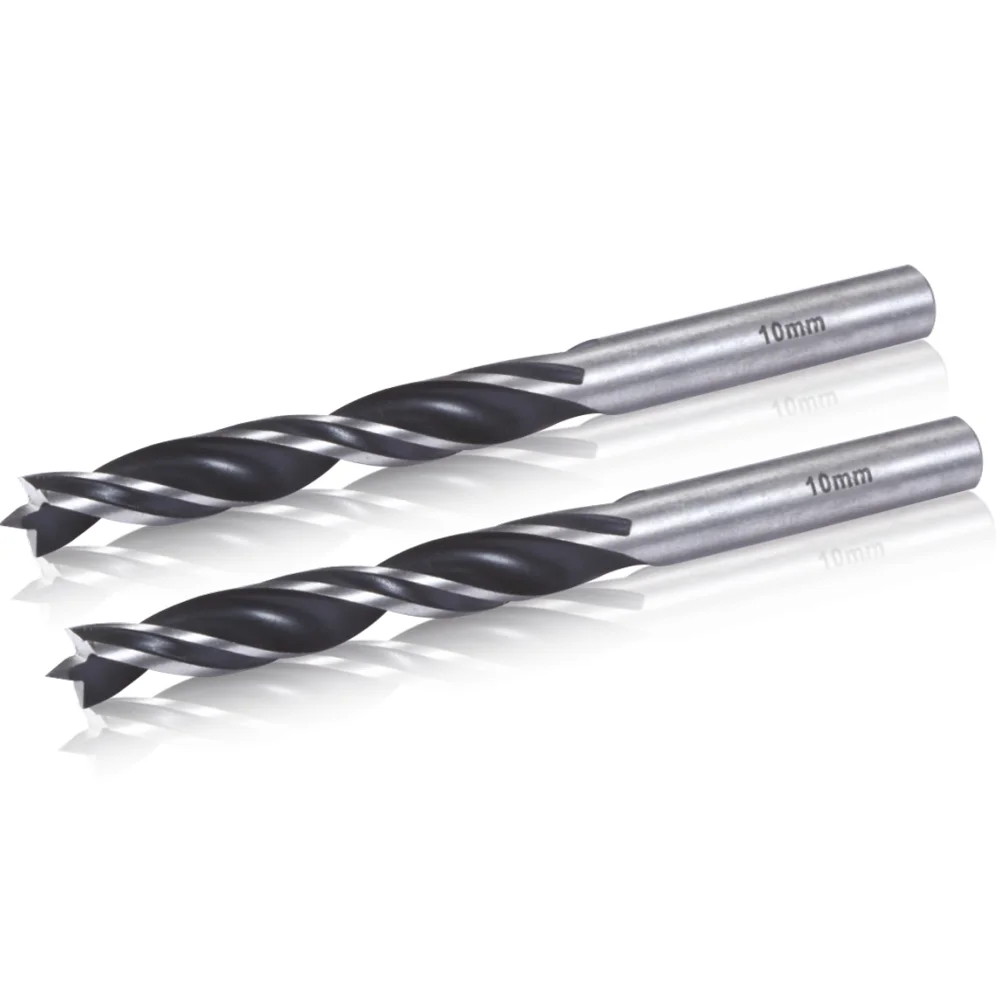
Anti-Chipping Boring Bits for Double-Sided Melamine
Why Furniture Factories Struggle with Double-Sided Melamine Drilling?
For furniture factories, drilling holes in double-sided melamine boards can indeed be a very tricky problem.
This situation usually occurs because the surface laminate of the board is too brittle. When the drill bit enters or exits the board, if the cutting force is not precise enough, or the drill bit’s edge is not sharp enough, it can easily chip off a piece of the brittle surface layer instead of cutting it cleanly.
In addition, if the drilling machine’s speed and feed rate are not well-coordinated, or if the drill bit has been used for a long time and has become worn, the risk of chipping increases. This not only affects the overall appearance of the furniture but also leads to material waste, increasing production costs.
-
Extremely Brittle Surface: The melamine coating on these boards is very hard and brittle, much like a thin layer of glass. When a standard drill bit enters the board, the compression force easily cracks the edges, leading to unsightly chipping.
-
Uneven Pressure on Both Sides: When the bit enters the front, the pressure is directed inward. However, as it exits the back, the pulling force of the flutes pushes outward against the material. Without pre-cutting the back surface, the bit will literally push the laminate away from the core, causing large blowouts.
-
Incorrect Drill Bit Structure: Many factories using standard wood bits lack the “score first, drill second” feature. Professional anti-chipping bits have two sharp outer spurs that score a clean circle through the brittle laminate before the main cutting edge engages, preventing the bit from tearing the edges.
-
Machine Stability and Parameters: If the boring machine’s spindle is not precise or has slight runout (wobbling), the cut will be uneven. Additionally, if the feed rate is too fast or the RPM is mismatched, the cutting action becomes too aggressive, which significantly worsens chipping.
-
Dull Tooling: Carbide bits lose their sharpness over time, especially on the outer scoring spurs. Once the edge is dull, it starts “smashing” through the laminate instead of slicing it. Even the best machinery cannot produce a clean hole if the bit is not sharp.
How Anti-Chipping Boring Bits Improve Efficiency and Quality?
Anti-chipping drill bits provide very direct benefits for furniture production, mainly in terms of improving efficiency and quality.
Because the edges of the drilled holes are extremely clean, there’s no need for workers to spend extra time manually repairing chipped points or sanding burrs. After cutting, the boards can go straight into assembly, naturally speeding up production.
At the same time, since these drill bits can precisely cut through brittle laminates, the scrap rate of materials is greatly reduced, avoiding situations where a single bad hole would ruin an entire board.
Moreover, the drill bits themselves are made from wear-resistant materials, so they need to be replaced less frequently and can ensure consistent, neat results over long periods of use.
Overall, using this kind of tool not only makes the furniture look more premium but also helps factories save a significant amount of hidden costs.
-
Minimizing Waste and Rework: Standard bits often cause blowouts on the back of the board, which usually cannot be repaired and results in the entire panel being scrapped. Anti-chipping bits ensure clean holes on both sides, eliminating the need to fix burrs or re-cut panels.
-
Enhancing Final Product Aesthetics: For high-end furniture or cabinetry, the cleanliness of hinge holes and shelf support holes defines the overall quality. These bits create mirror-smooth edges, allowing hardware to fit perfectly flush against the board.
-
Increasing Production Speed: Since these bits feature specialized scoring spurs, they encounter less resistance and cut more smoothly upon entry. Operators don’t need to intentionally slow down the feed rate to prevent chipping, allowing the machine to maintain a high-speed rhythm and shorten production cycles.
-
Extending Tool Life: Anti-chipping bits are typically made from high-quality Tungsten Carbide (TCT). Although the initial cost is higher, their scientific design ensures even force distribution and superior wear resistance, which reduces downtime caused by frequent tool changes and sharpening.
-
Simplifying Downstream Processes: When hole edges are clean and crisp, subsequent tasks like installing fittings or edge banding become much easier. There is no need for manual labor to clean up debris or burrs around the holes, which boosts the overall efficiency of the assembly line.
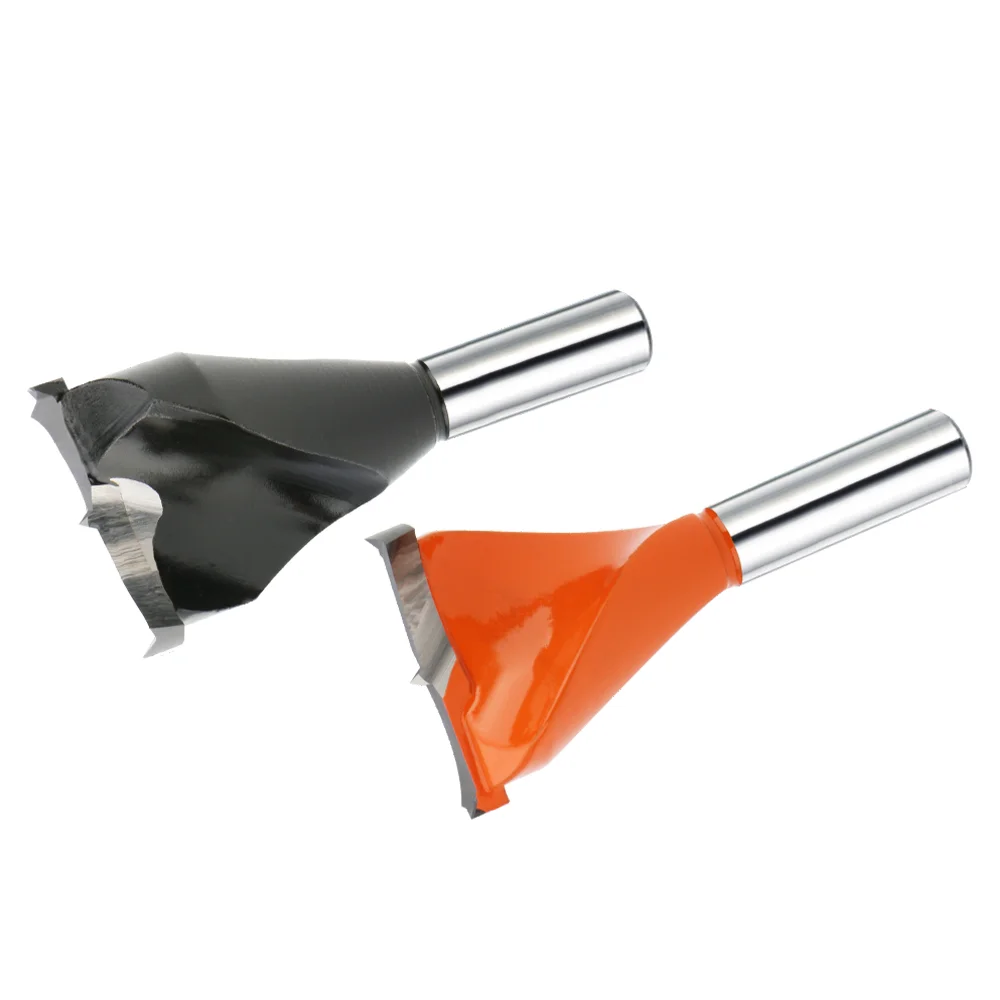
Premium-TCT-Split-Type-Brad-Point-Boring-Bit
Choosing the Right Anti-Chipping Boring Bits for Your CNC Furniture Production
In CNC furniture production, choosing the right anti-chipping drill bit is extremely important, as it directly affects the quality of the board processing.
1. Geometry: V-Point vs. Brad Point
The geometric structure of the bit determines how it engages with the panel fibers.
-
V-Point Bits (Through-Hole Bits):
-
Features: Designed with a sharp central point and two peripheral cutting spurs.
-
Best For: Through-holes. The outer spurs cut the surface fibers before the bit exits the back of the panel, preventing “blowout” on the bottom side.
-
-
Brad Point Bits (Blind-Hole Bits):
-
Features: Designed with a flat bottom and sharp scribing edges.
-
Best For: Blind holes (e.g., cam and bolt holes). These ensure the top entry edge is crisp and free of burrs without drilling through the board.
-
2. Materials and Coatings
In mass production, durability directly impacts your bottom line.
-
Tungsten Carbide Tipped (TCT): The industry standard. It offers excellent hardness and wear resistance for general wood processing.
-
Polycrystalline Diamond (PCD): If you process high-density boards or abrasive materials, PCD bits last dozens of times longer than TCT. They maintain a razor-sharp edge for extended periods, significantly reducing the risk of chipping.
-
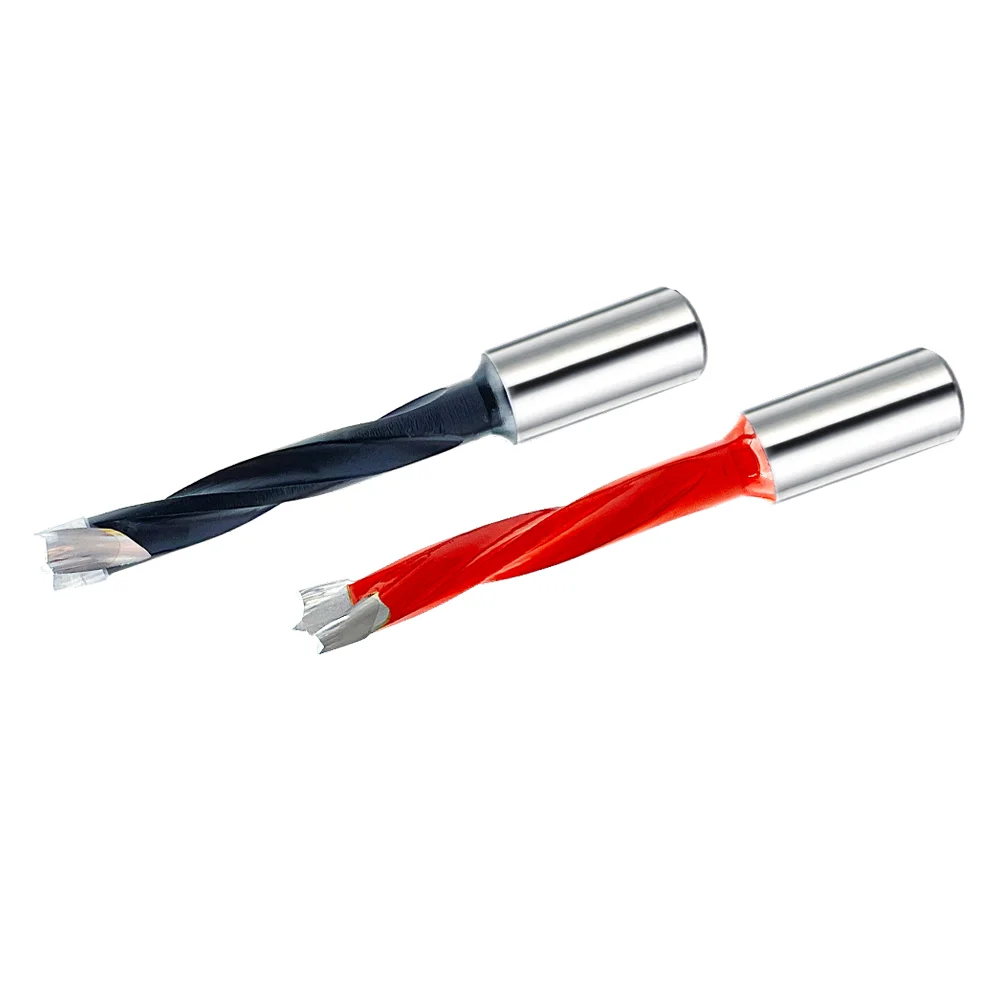
PTFE (Teflon) Coating: Often color-coded (black or orange). This coating reduces friction and improves chip evacuation, preventing heat buildup that can scorch the panel or cause edge failure.
3. Key Parameters for Chipping Prevention
| Parameter | Recommended Value / Impact |
| Rotation Speed (RPM) | Typically 4,000 – 8,000 RPM. Too low causes chipping; too high causes burning. |
| Feed Rate | Maintain steady pressure. Feeding too fast “crushes” the edge; feeding too slow dulls the tool. |
| Direction | Ensure you distinguish between Left-Hand (LH/Red) and Right-Hand (RH/Black) bits based on your boring head configuration. |
4. Three Checkpoints Before Purchasing
-
Edge Sharpness: High-quality anti-chipping bits have a microscopic, uniform edge. Any “nicks” in the carbide will result in immediate chipping.
-
Flute Smoothness: Check if the discharge flutes are polished. Poor chip evacuation is a “hidden killer” that causes internal pressure and edge breakout.
-
Shank Precision: Ensure the shank (usually 10mm) has a tight tolerance. Any “run-out” (wobble) during high-speed rotation will enlarge the hole and shatter the edges.
Case Study: How ZC Tools Anti-Chipping Drill Bits Helped a Furniture Factory Reduce Waste and Boost Productivity?
Background
Client: A large-scale custom furniture manufacturer specializing in Melamine Faced Chipboard (MFC) and High-Gloss panels.
Production Scale: Operates 12 high-speed CNC boring centers, producing 1,500 panel components daily.
The Challenges:
-
High Chipping Rate: Using standard bits, the exit holes frequently suffered from 1–2mm breakouts. This led to a 4% reject rate.
-
High Labor Costs: Workers spent hours manually repairing edges with filler, or expensive high-gloss panels had to be scrapped entirely.
-
Short Tool Life: Standard bits became dull after only 500 holes, causing frequent downtime for tool changes.
The ZC Tools Solution
After an on-site technical assessment, ZC Tools implemented its PCD (Polycrystalline Diamond) Anti-Chipping Series along with optimized machining parameters.
1. Precision V-Point Geometry
ZC Tools bits feature a patented Ultra-Sharp Peripheral Spur design. At the exact moment the bit penetrates the back of the board, these spurs act like a scalpel, pre-cutting the surface fibers to ensure a perfectly clean exit with zero breakout.
2. PTFE (Teflon) Friction Reduction
The bits are coated with the signature ZC Tools Orange PTFE Coating.
-
Function: This reduces friction within the flutes, preventing “chip packing” and the localized heat buildup that often scorches panel edges.
-
Result: Even at high speeds of 8,000 RPM, the hole walls remain smooth and mirror-like.
3. PCD Material Upgrade
For high-density materials, ZC Tools upgraded the factory from traditional TCT bits to the PCD Diamond Series, offering extreme hardness and edge retention.
Performance Comparison
| Metric | Before ZC Tools | After ZC Tools | Improvement |
| Edge Chipping Rate | 4.2% | 0.3% | 92% Reduction |
| Tool Life (per bit) | ~600 holes | 15,000+ holes | 25x Increase |
| Daily Downtime | 45 mins/day | 10 mins/week | Significant Boost |
| Manual Rework | 3 repair stations | Eliminated | Major Labor Savings |
Conclusion
ZC Tools has demonstrated that through precision geometry and advanced material science, even a small component like a drill bit can have a massive impact on factory-wide profitability and brand reputation. Investing in the right tool is an investment in the quality of the final product.