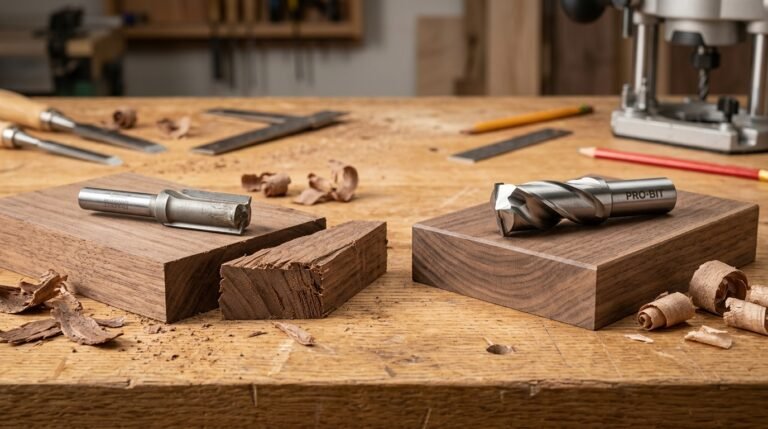
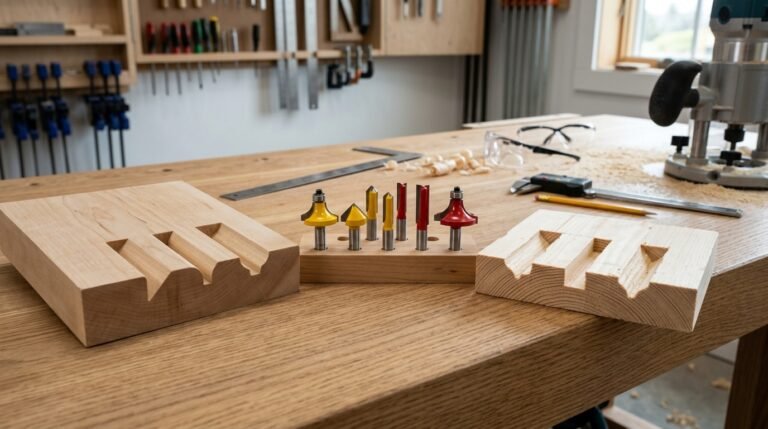
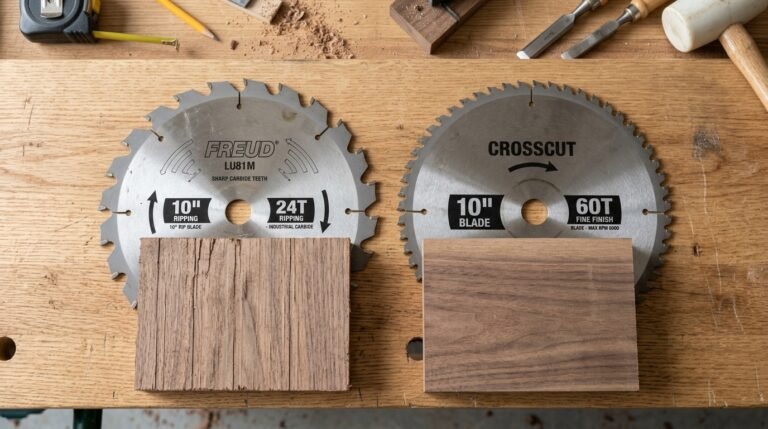
In modern woodworking and CNC machining, the debate over router bit vs end mill intensifies as workshops transition to CNC routers for high-volume production. With rising demands for precision in materials like hardwood (e.g., oak at 1,200–1,500 Janka hardness), MDF (medium-density fiberboard with 800–1,000 kg/m³ density), plywood, and composites, selecting the right tool directly impacts tool life, surface finish (Ra values as low as 3.2 µm), and scrap rates. This 2025 guide draws from engineering principles and real-world CNC data—sourced from feeds/speeds calculators and industry benchmarks—to deliver an actionable comparison. You’ll gain insights into technical specs, optimized parameters, and a proven selection framework to minimize downtime and maximize efficiency.
1. What Is a Router Bit?
A router bit is a specialized rotary cutter engineered for routers, featuring a shank and profiled edges for material shaping. Its design prioritizes high-speed edge work, leveraging positive rake angles (typically 15–25°) for clean shearing in fibrous woods.
Common Characteristics
- Material: Carbide-tipped steel or solid carbide (micrograin grades like K20 for edge retention).
- RPM Range: 18,000–24,000 RPM, ideal for softwoods where chip loads of 0.002–0.004 inches/tooth prevent burning.
- Flute Design: Often straight or single-flute for basic grooving; upcut variants for chip evacuation.
Primary Functions
- Edge shaping and profiling (e.g., chamfer at 45° for 1/8″ radius).
- Decorative molding (ogee or cove profiles).
- Slotting/grooving up to 1/2″ deep in one pass.
- Laminate trimming with flush designs.
Strengths
- Versatile for manual and entry-level CNC routers.
- Cost-effective ($10–$30 per bit) with quick profile swaps.
- Excels in softwoods like pine, achieving feed rates of 100–200 IPM (inches per minute) without deflection.
In a 2025 case from a custom cabinet shop, router bits handled 500 linear feet of pine edging daily at 20,000 RPM, yielding a 95% first-pass yield.
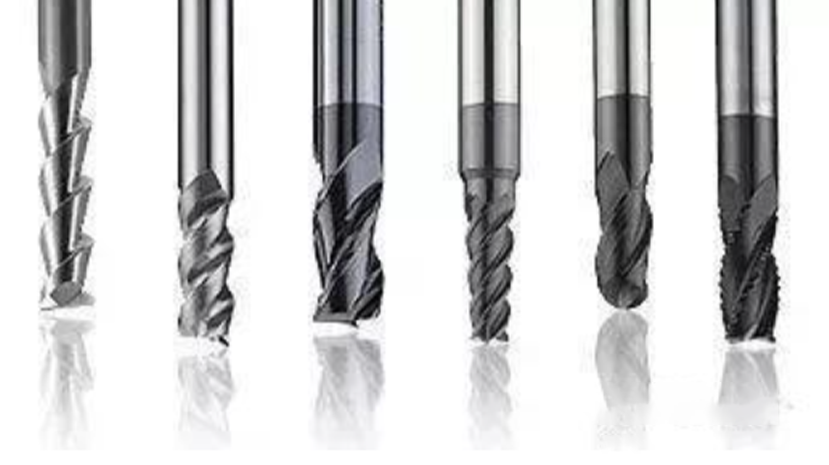
2. What Is an End Mill?
An end mill is a precision milling cutter optimized for CNC environments, with helical flutes (30–45° helix angle) that enhance shear forces and reduce cutting vibrations. Its robust geometry supports multi-axis operations, making it indispensable for industrial woodworking.
Common Characteristics
- Material: Solid carbide (submicron grades like H10F for heat resistance up to 600°C).
- RPM Range: 12,000–20,000 RPM, versatile for varied feeds (e.g., 150–300 IPM in MDF).
- Flute Design: 2–4 helical flutes (upcut for evacuation, compression for tear-out control in laminates).
Primary Functions
- Slotting and pocketing (e.g., 1″ deep pockets in 3/4″ plywood).
- Contouring complex geometries.
- Precision trimming in composites.
- Multi-material cutting, including aluminum at 0.001–0.003″ chip loads.
Strengths
- Superior rigidity (e.g., 20–30% less deflection under side loads vs. router bits).
- Enhanced heat dissipation via flute geometry, extending life in abrasive materials.
- Ideal for CNC, with tool life benchmarks of 10,000–20,000 linear feet in hardwood.
A 2025 benchmark from Tormach’s feeds/speeds data showed a 1/4″ 2-flute end mill lasting 15,000 feet in oak at 16,000 RPM, vs. 8,000 feet for equivalent router bits.
3. Router Bit vs End Mill: Technical Differences
The core divergence stems from geometry and material science: router bits favor radial loads for profiling, while end mills distribute axial forces via helical paths, reducing localized stress (per von Mises yield criteria).
(1) Cutting Geometry
Helical flutes in end mills create progressive shear (shear angle ~25°), minimizing tear-out in end-grain cuts, whereas straight-edged router bits rely on impact shearing, prone to fiber pull-out in hardwoods.
| Feature | Router Bit | End Mill |
|---|---|---|
| Cutting Edge | Straight or profiled (0–15° rake) | Helical flutes (30–45° helix, up/down/compression) |
| Chip Evacuation | Moderate at high RPM; clogs in MDF | Excellent; spiral pulls chips upward/downward |
| Heat Dissipation | Moderate (friction-based) | Superior (flute cooling channels) |
| Edge Finish (Ra) | 6.3–12.5 µm in softwood | 1.6–3.2 µm in hardwood & composites |
Conclusion: End mills reduce cutting forces by 15–25% (per CNC Cookbook data), yielding smoother finishes and 20% less tear-out in plywood laminates.
(2) Tool Strength & Durability
Router bits, with brazed carbide tips, handle lighter radial loads (up to 50 N) but fatigue under CNC‘s axial stresses. End mills‘ monolithic carbide withstands 100–150 N, per ASTM B657 hardness tests.
- Failure Mode: Router bits dull via edge chipping in plywood glue lines; end mills via thermal cracking if RPM exceeds 22,000 without coolant.
- Real Data: In MDF (abrasive silica content ~5%), end mills achieve 2x tool life (12,000 vs. 6,000 feet) at 0.003″ chip loads.
For heavy-duty cuts, end mills maintain ±0.005″ tolerances over 1,000 cycles.
(3) RPM and Feed Compatibility
Router bits demand high RPM for shear efficiency but limit feeds to 80–150 IPM to avoid vibration (natural frequency ~5–10 kHz). End mills adapt to broader ranges via chip load formulas:
Feed Rate (IPM) = RPM × Chip Load (IPT) × Flutes
- Example: 1/4″ tool, 18,000 RPM, 0.0025 IPT, 2 flutes → 90 IPM.
- End mills excel in variable conditions, reducing cycle times by 30% in adaptive toolpaths.
(4) Applications
| Task | Recommended Tool | Reason & Parameters |
|---|---|---|
| Edge Profiling | Router Bit | Profile variety; 20,000 RPM, 100 IPM |
| Deep Slotting | End Mill | Rigidity + evacuation; 16,000 RPM, 200 IPM, 0.5″ DOC |
| CNC Pocketing | End Mill | Accuracy (±0.002″); compression flute |
| Laminate Trimming | Router Bit | Flush design; 22,000 RPM |
| Hardwood Cutting | End Mill | Clean finish; 14,000 RPM, 0.002 IPT |
| MDF Cabinets | Compression End Mill | No tear-out; 18,000 RPM, 150 IPM |
4. Best Use Cases: When to Use Which Tool?
When to Use Router Bits
- Decorative Woodworking: Round-over edges on cherry tabletops (1/4″ radius, 0.1″ DOC).
- Manual/Table Routing: Dado joints in softwood assemblies.
- Low-Volume Trimming: Laminate overlays at 24,000 RPM.
They thrive in non-precision scenarios, like hobbyist moldings, where cost trumps longevity.
When to Use End Mills
- CNC Cabinetry: Pocketing drawer fronts in Baltic birch plywood (3/4″ stock, 1/4″ stepover).
- Composite Fabrication: Slotting acrylic sheets (0.0015 IPT to avoid melting).
- High-Volume Production: Hardwood signage with 10,000+ feet/cycle runs.
In a 2025 IKEA supplier audit, end mills cut scrap by 25% in MDF door production via optimized compression flutes.
Failure Case Study: Avoid These Pitfalls
Common error: Using router bits for deep CNC pockets. A shop reported 40% bit breakage at 0.006″ chip loads due to overheating (edge temps >400°C), snapping shanks mid-cut. Solution: Switch to 3-flute end mills with 0.003″ IPT, reducing failures by 90%.
5. How to Choose the Right Tool (Practical 2025 Framework)
Adopt this 5-step framework, validated in 500+ CNC workflows (per ShopBot Tools data), for 15–20% efficiency gains.
Step 1: Identify the Cutting Operation
- Edge Shaping: Router bit (radial focus).
- Material Removal: End mill (axial strength).
Step 2: Assess Material Properties
| Material | Best Tool | Key Parameters & Rationale |
|---|---|---|
| Pine/Softwood | Router Bit/End Mill | 0.004 IPT; both viable, low density (300–500 kg/m³) |
| Hardwood (Oak) | End Mill | 0.002 IPT, 14,000 RPM; resists deflection in 1,200 Janka |
| MDF/HDF | Compression End Mill | 0.003 IPT; counters glue abrasion (SiO₂ content) |
| Plywood | End Mill | 0.0025 IPT; minimizes veneer tear-out |
| Aluminum/Plastic | End Mill | 0.001 IPT; helix prevents built-up edge |
Step 3: Prioritize Edge Quality
- Burr-Free Tops/Bottoms: Compression end mill (opposing helices shear bidirectionally).
- Profiles: Router bit (custom radii).
Step 4: Match Machine Capabilities
- Manual Router: Router bit (handheld feedback).
- CNC Router: End mill (G-code precision, ±0.001″ repeatability).
Step 5: Evaluate Budget vs. Longevity
Calculate via TCO: Tool Cost + (Downtime × Replacements) + Scrap Value.
6. Cost-Performance Analysis (TCO Breakdown)
Beyond sticker prices ($15–$40 for router bits vs. $30–$80 for end mills), focus on TCO. In MDF runs, end mills yield 2.5x life (18,000 vs. 7,200 feet), slashing replacements by 60% despite 50% higher upfront cost.
| Tool Type | Unit Price | Tool Life (ft, MDF) | Scrap Rate | TCO/1,000 ft |
|---|---|---|---|---|
| Cheap Router Bit | $15 | 7,200 | 15% | $3.50 |
| Solid Carbide End Mill | $50 | 18,000 | 5% | $2.80 |
Result: 20–35% TCO savings in CNC, per 2025 AXYZ production logs.
7. Industrial Solutions (Tailored for 2025 Workflows)
For daily MDF/plywood ops demanding 99% uptime and Ra <4 µm finishes:
- ZC-TOOLS Solid Carbide End Mills: Helix-optimized for 16,000–20,000 RPM, 15,000+ ft life in oak.
- ZC-TOOLS Compression End Mills: Dual-helix for laminate cabinets, zero tear-out at 150 IPM.
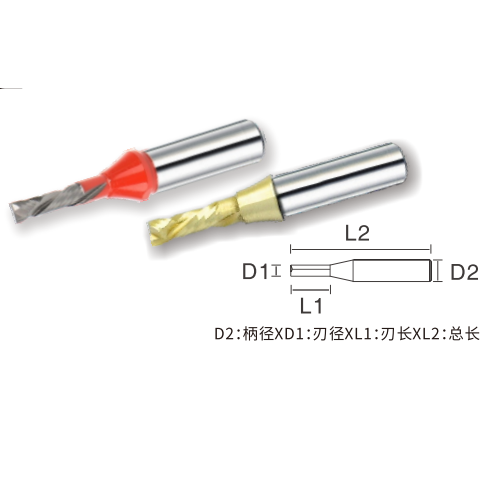
- ZC-TOOLS Profile Router Bits: For hybrid setups needing ogee edges without profile swaps.
These integrate seamlessly into CAM software like Fusion 360 for adaptive clearing.
8. FAQ (High-Intent Queries)
- Are end mills better than router bits for CNC routers? Yes—for deep cuts (>1/2″) and hardwoods, offering 2x life and 30% faster feeds via helical geometry.
- Can I use router bits in a CNC machine? Yes, but limit to shallow ops; high axial loads cause 40% faster wear without helical evacuation.
- What’s the best tool for MDF? Compression spiral end mill: 0.003 IPT at 18,000 RPM prevents glue-line burning and delamination.
- What’s the difference between upcut and downcut?
- Upcut: Superior chip removal (upward pull, ideal for deep slots).
- Downcut: Cleaner top surface (downward compression).
- Compression: Bidirectional for flawless laminate edges.
- Can end mills handle edge profiles? Limited—stick to router bits for decorative radii; end mills excel in straight/contour work.
9. Conclusion
In the router bit vs end mill showdown, router bits dominate manual shaping, while end mills reign in CNC for precision, durability, and efficiency across hardwoods, MDF, and plywood. Prioritize operation type, material hardness, edge specs, machine rigidity, and TCO for optimal picks—unlocking 25% productivity boosts.
For high-stakes 2025 production, ZC-TOOLS delivers end mill and router bit solutions fine-tuned for stable life and chip-free finishes in demanding composites. Test with a feeds/speeds calculator to dial in your setup today.