Tear-out is one of the most frustrating defects in CNC woodworking—especially when cutting plywood, MDF, melamine, veneered panels, and solid hardwood. Even with high-end CNC routers and premium tooling, chipped edges can still appear if cutting forces, tool geometry, or feed parameters aren’t optimized.
This 2025 expert guide explains—from a professional engineering perspective—how tear-out happens, how to prevent it, and how to choose the correct CNC router bits to completely eliminate surface defects in modern production environments.
1. What Is Tear-Out in CNC Woodworking?
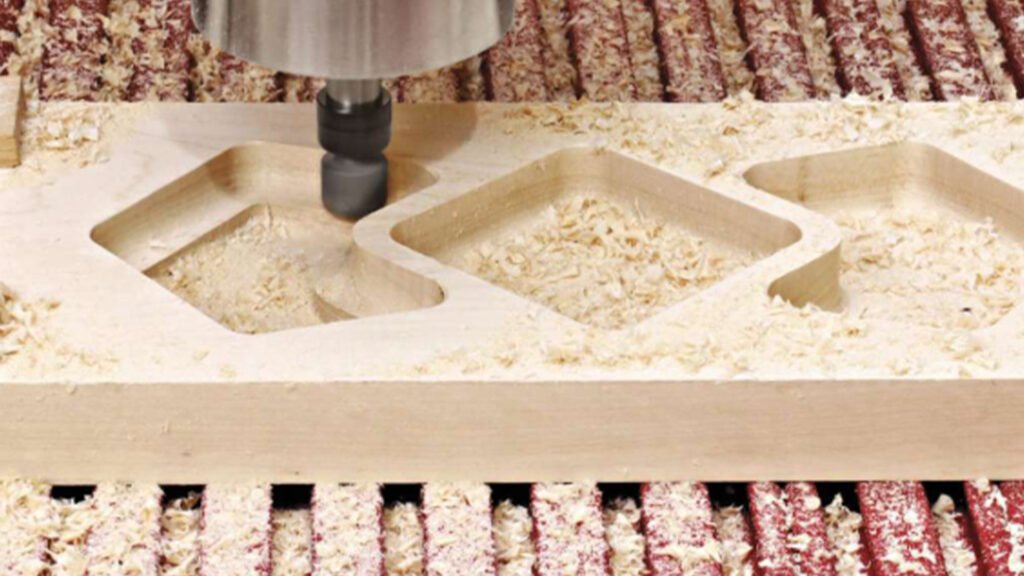
Tear-out happens when the cutting tool lifts wood fibers instead of shearing them cleanly. Fibers fracture and separate from the surface, producing fuzzy edges, splintering, or chipped laminate.
Tear-out often occurs:
- at the edges of plywood veneers
- on brittle melamine coatings
- when cutting against grain direction
- when using the wrong flute geometry
- when RPM and feed rates are poorly matched
- when the tool is worn, overheated, or vibrating
Tear-out reduces product quality, increases rework, and creates scrap—especially in cabinet and furniture manufacturing lines.
2. Why Tear-Out Happens: Scientific & Technical Breakdown
Understanding the physics behind tear-out is essential. Tear-out is the result of fiber lifting, which occurs when cutting forces push wood fibers in the wrong direction.
Below are the six primary technical causes.
2.1 Grain Direction Conflicts
Wood fibers behave like bundles of aligned threads. When cutting forces exceed the fiber’s shear strength:
- fibers break upward (top tear-out)
- fibers break downward (bottom tear-out)
This is why flute direction matters enormously.
2.2 Alternating Layers in Plywood
Plywood layers alternate grain direction every sheet. The result:
- Top veneer → prone to upward tear-out
- Bottom veneer → prone to downward tear-out
This is exactly why compression bits were invented—to cut both directions cleanly.
2.3 Wrong Flute Geometry
Your choice of upcut, downcut, or compression bit directly controls the direction of cutting forces.
| Tool Type | Fiber Direction Effect | Tear-Out Risk |
|---|---|---|
| Upcut bit | Pulls fibers upward | Top tear-out |
| Downcut bit | Pushes fibers downward | Bottom tear-out |
| Compression bit | Push + pull | No tear-out |
| Straight flute | Neutral | Inconsistent on laminates |
Wrong geometry = instant chipping.
2.4 Poor Workpiece Stability
If the panel vibrates even slightly:
- cutting forces become erratic
- fibers detach unpredictably
- chips re-enter the cut path
- edges splinter
Vacuum pressure and clamping play a major role in tear-out prevention.
2.5 Incorrect Feed & Speed Settings
Incorrect chip load causes multiple surface defects:
- Too slow → heat, burning, fiber lifting
- Too fast → forced chipping
- Too small chip load → rubbing, not cutting
- Too large chip load → violent tear-out
Proper balance ensures clean shearing.
2.6 Dull or Overheated Tooling
A dull edge compresses fibers instead of slicing them. Overheated carbide loses hardness, and coating performance decreases—making tear-out unavoidable.
3. Material-Specific Tear-Out Behavior
Different materials fracture differently. This is critical when selecting tooling.
| Material | Tear-Out Risk | Reason |
|---|---|---|
| Plywood | Very High | Alternating grains, brittle veneers |
| Melamine | High | Hard but fragile coating |
| MDF / HDF | Medium | Uniform fiber but burns easily |
| Hardwood | Medium | Grain direction + knots |
| Softwood | Low | Soft fibers, easier shearing |
Understanding material behavior is the foundation of controlling tear-out.
4. Tool Selection: The Most Important Factor in Tear-Out Prevention
4.1 Compression Bits (Best Overall for Tear-Out Prevention)
A compression bit combines:
- downcut at the top (push fibers down)
- upcut at the bottom (pull fibers up)
This pulls both surfaces inward, resulting in zero tear-out.
Best For:
- Plywood
- Melamine
- Veneered panels
- Cabinet components
- Full-depth CNC nesting
Why It Works:
The upward and downward cutting forces meet in the middle, creating a neutral zone that prevents any fiber from escaping.
4.2 Downcut Bits (Best for Clean Top Surface)
A downcut bit applies downward pressure to keep the top veneer intact.
Use When:
- cutting dadoes
- shallow grooves
- finishing top-visible surfaces
- trimming laminated surfaces
Avoid: deep passes (they trap chips and overheat).
4.3 Upcut Bits (Best for Deep Cuts & Strong Chip Evacuation)
Upcut bits are ideal for aggressive cutting:
Use For:
- deep slotting
- pocketing
- hardwood machining
- fast roughing
- removing chips from deep cavities
Risk: top tear-out on high-end panels.
4.4 Straight Flute Bits
Neutral geometry. Good for softwood, but not recommended for melamine or plywood if clean edges are required.
4.5 Special Geometry Tools
- Chipbreaker bits → ultra-aggressive roughing
- Shear-cut bits → angled cutting edges for hardwood
- O-flute bits → plastic machining, eliminates melting
5. Essential CNC Parameters for Tear-Out Reduction
5.1 Chip Load Formula (Critical)
Chip Load = Feed Rate ÷ (RPM × Number of Flutes)
Small chip load → rubbing → heat → tear-out
Large chip load → aggressive cutting → chipping
Achieve a balanced chip thickness. This is fundamental.
5.2 Recommended Feed & Speed (2025 Updated)
Compression Bits
- Feed: 6–12 m/min
- RPM: 16,000–20,000
- Pass Depth: Full sheet when possible
Downcut Bits
- Feed: 3–6 m/min
- RPM: 18,000–22,000
- Pass Depth: < tool diameter
Upcut Bits
- Feed: 5–10 m/min
- RPM: 16,000–22,000
6. Workpiece Stability: The Hidden Variable
Even with perfect tooling, tear-out will occur if the workpiece moves.
Best Hold-Down Methods
- Vacuum table (high-pressure zones under plywood)
- Clamps around perimeter
- Double-sided tape + CA glue (small parts)
- Onion skin strategy
- Spoilboard resurfacing for flatness
The stiffer the workpiece, the cleaner the edge.
7. Toolpath Strategies to Prevent Chipping
7.1 Climb Cutting vs. Conventional Cutting
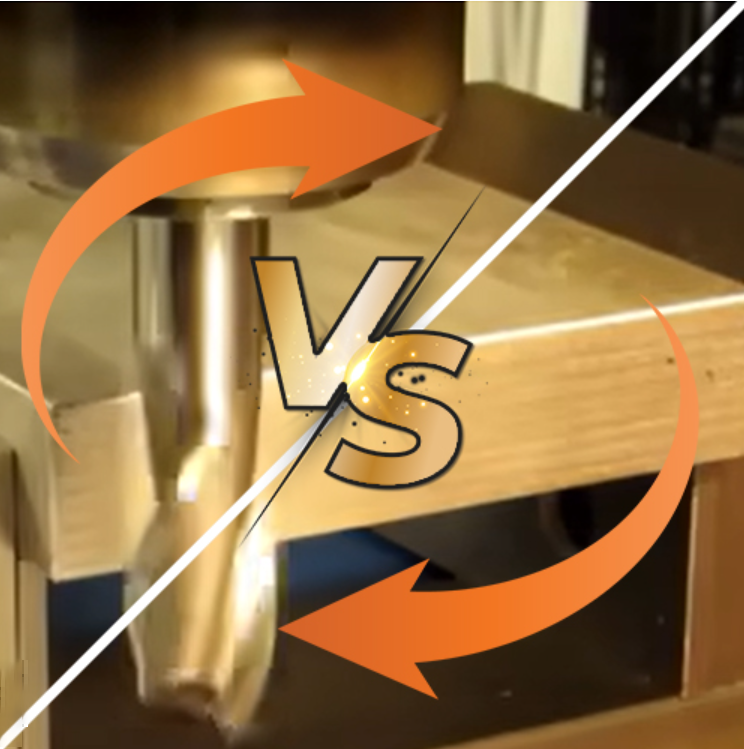
- Climb cutting = cleaner finish
- Conventional cutting = safer but rougher
Best practice:
→ Use climb cutting for your finishing pass.
7.2 Lead-Ins & Lead-Outs
Never start cutting directly on the final edge.
Use:
- ramp entry
- helical entry
- curved lead-out
These reduce edge fiber shock and splintering.
7.3 Scoring Pass Strategy
For laminates and plywood:
- 0.5–1 mm scoring pass
- Full-depth cut with a compression bit
This mimics panel saw scoring blades.
7.4 Onion Skin Method
Leave 0.2–0.5 mm at the bottom.
Remove it during the final pass to eliminate bottom chipping.
8. Real Industrial Case Studies (2025 Production Data)
Case 1: Cabinet Manufacturer Eliminates 80% Tear-Out
- Problem: Melamine chipping with upcut bits
- Solution: Switched to 3 mm compression bit, raised feed rate
- Result: Smooth edges at 8 m/min, zero scrap
Case 2: Solid Wood Table Factory
- Problem: Tear-out in oak due to directional grain
- Solution: Final pass using shear-downcut bit
- Result: No sanding required
Case 3: MDF Door Manufacturer
- Problem: Burning + micro-chipping
- Solution: Increased chip load, used polished upcut
- Result: Eliminated burning completely
Case 4: Furniture Plant Cutting Veneered Birch Panels
- Problem: Veneer tearing during nesting
- Solution: Switched from downcut to compression bit
- Result: Saved 15% rework time
Case 5: CNC Prototyping Lab
- Problem: Chipping around small features
- Solution: Adaptive clearing + climb finish pass
- Result: Perfect micro-features with sharp edges
9. Professional Tooling Solutions from ZC-TOOLS
For manufacturers who require clean edges, high feed speeds, and consistent tool life in 2025 CNC production, ZC-TOOLS provides engineered solutions designed for industrial performance:
- ZC-TOOLS compression bits for plywood, melamine & laminated boards
- ZC-TOOLS downcut bits for perfect top-surface quality
- ZC-TOOLS upcut bits for deep slotting & rapid material removal
- ZC-TOOLS shear bits for hardwood finishing
Built for cabinet factories, furniture plants, and OEM manufacturers needing reliable, chip-free cutting performance.
10. FAQ
Q1. Why do I still get tear-out when using a compression bit?
You’re not cutting deep enough to reach the upcut section. Increase pass depth.
Q2. Why does melamine chip so easily?
Its brittle coating fractures when pushed upward by incorrect cutting forces.
Q3. Why does increasing feed rate sometimes improve cut quality?
Higher feed rate increases chip load, which results in cleaner slicing.
Q4. Are downcut bits safe for deep cuts?
No. They trap chips and generate heat, leading to burning and tool wear.
11. Conclusion
Preventing tear-out is a science rooted in:
- material behavior
- cutter geometry
- CNC parameters
- workpiece stability
- toolpath strategy
In 2025, the most effective approach for clean cutting in CNC woodworking is:
- Compression bits for laminated panels and plywood
- Downcut bits for clean top surfaces
- Upcut bits for deep cuts and efficient chip evacuation
Use the right tool, correct chip load, and stable workholding—and tear-out becomes a problem of the past.