Roughly 80% of tear-out, burn marks, and rough edges on woodworking projects trace back to one mistake: using the wrong blade for the cut direction. The difference between rip and crosscut saw blade comes down to tooth count, tooth geometry, and hook angle — rip blades use fewer, aggressive teeth (typically 24) with a high hook angle to slice along the wood grain, while crosscut blades pack 60–80 finely beveled teeth at a lower hook angle to sever fibers across the grain cleanly. Understanding which blade matches your cut isn’t just academic — it directly determines cut quality, feed speed, motor strain, and whether you’ll spend an extra hour sanding.
Rip vs. Crosscut Saw Blades at a Glance
The difference between rip and crosscut saw blade comes down to one thing: grain direction. A rip blade slices along the wood grain like splitting kindling, while a crosscut blade severs fibers across the grain for smooth, tear-free edges. Choosing the wrong one costs you finish quality, wastes material, and strains your table saw motor.
| Feature | Rip Blade | Crosscut Blade |
|---|---|---|
| Tooth Count (10″) | 24–30 teeth | 60–80 teeth |
| Hook Angle | 18°–22° (aggressive) | 5°–15° (shallow) |
| Tooth Geometry | Flat-top grind (FTG) | Alternate top bevel (ATB) |
| Kerf Width | Wider (~1/8″) | Thinner (~3/32″) |
| Cut Direction | With the grain | Across the grain |
| Feed Rate | Fast, chip-clearing | Slower, precision-focused |
| Typical Finish | Rougher — needs jointing | Clean, ready for glue-up |
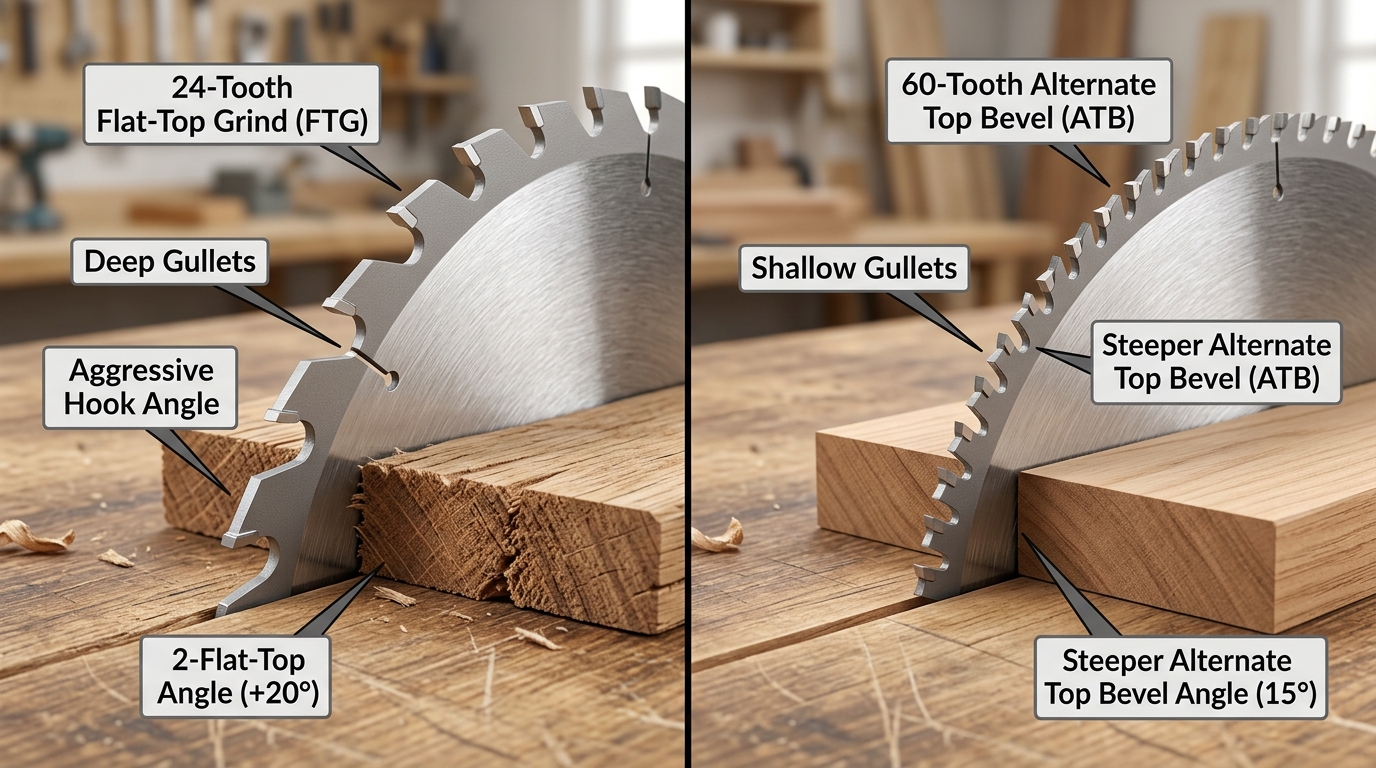
Fewer, larger teeth on a rip blade act like tiny chisels, scooping material out quickly. The steep hook angle pulls stock into the blade, boosting feed speed. Crosscut blades take the opposite approach — densely packed ATB teeth shear wood fibers cleanly, preventing the splintering that ruins visible edges.
Understanding this difference between rip and crosscut saw blades is the first step toward smarter tool selection. For a broader look at blade types and other cutting tools, see our industrial woodworking cutting tools buyer’s guide. If you need precision-engineered blades built for professional ripping or crosscutting, explore the ZC-TOOLS saw blade series.
What Is a Rip Saw Blade and How It Cuts With the Grain
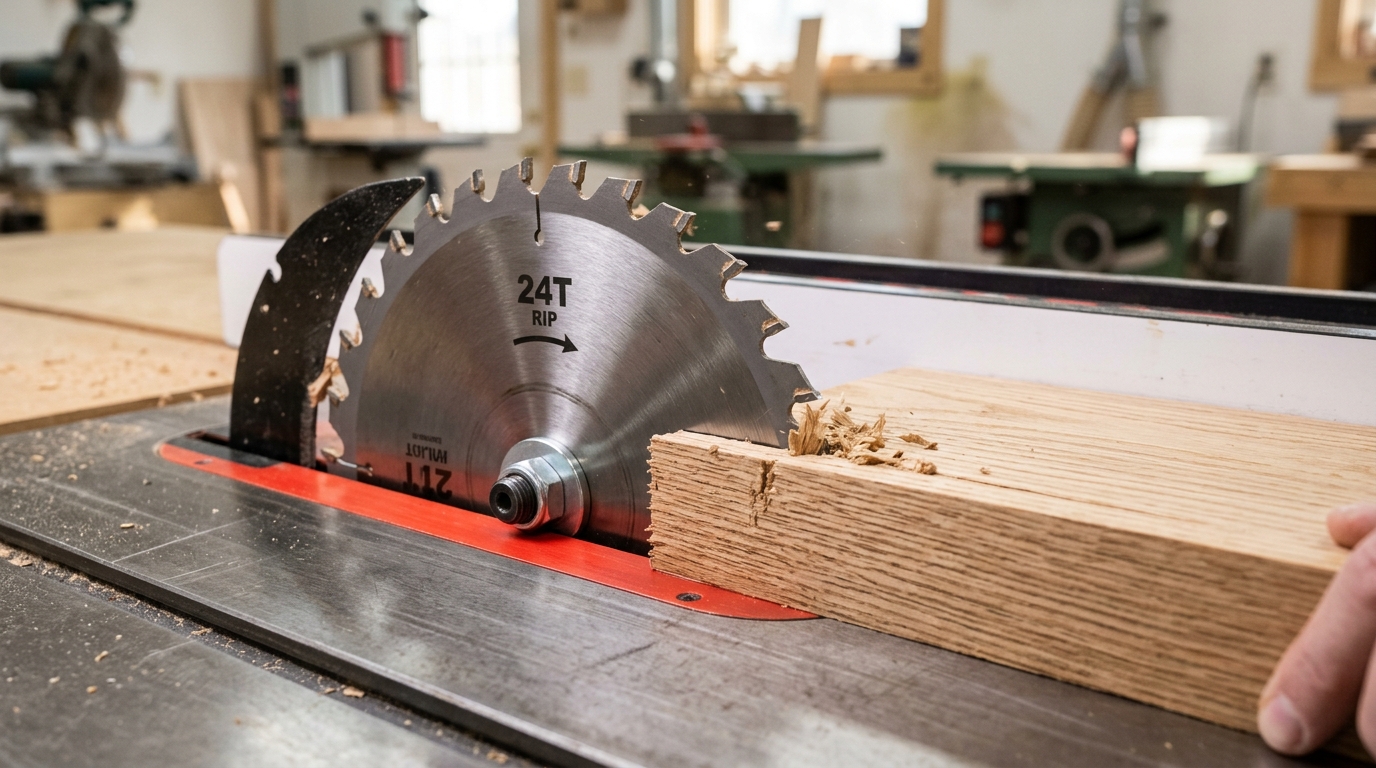
A rip saw blade is purpose-built to cut parallel to the wood grain — the same direction fibers run through a board. Think of it as a series of tiny chisels, each one scooping out material rather than slicing across it. This aggressive cutting action is what separates rip blades from every other blade type on your table saw.
Flat-Top Grind (FTG) Tooth Geometry
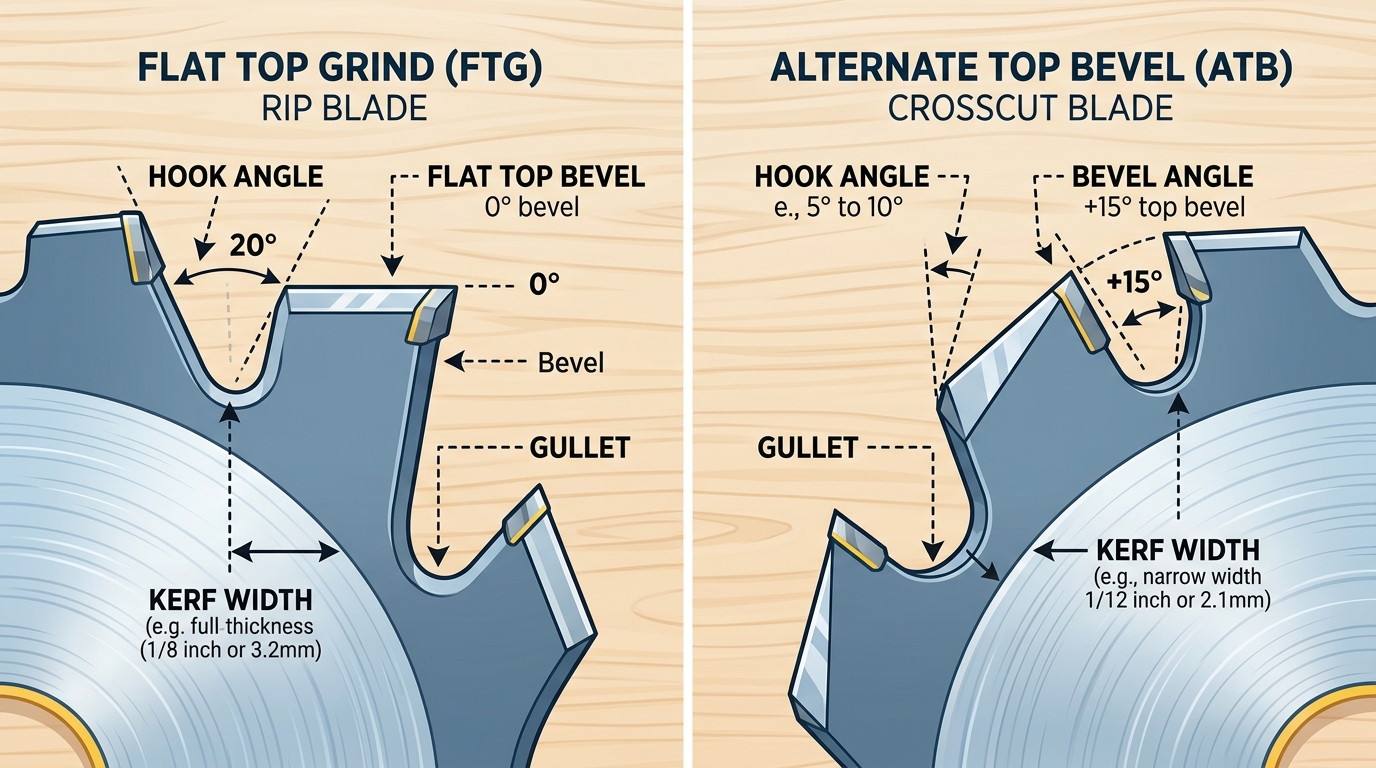
The defining feature is the flat-top grind, or FTG. Each carbide tooth has a perfectly square face with no bevel or alternating angle. This geometry acts like a chisel, plowing straight through wood fibers instead of shearing them. The result? Fast, efficient stock removal when ripping lumber to width.
Low Tooth Count and Wide Gullets
Rip blades typically carry 16 to 30 teeth on a standard 10-inch diameter. Fewer teeth means larger gullets — the valleys between each tooth — which clear chips rapidly and prevent sawdust from packing the kerf. This is critical during long rip cuts where material removal rates are high.
Aggressive Hook Angle
Most rip blades feature a hook angle around 18° to 22°. That steep positive angle pulls the workpiece into the blade, delivering a fast, assertive feed rate. It’s one reason understanding the difference between rip and crosscut saw blade designs matters so much — using a blade with the wrong hook angle changes how the wood behaves at the fence entirely.
For workshops processing solid hardwood at volume, a dedicated rip blade from a quality manufacturer like ZC-TOOLS can cut feed times nearly in half compared to a general-purpose blade.
If you’re building your first serious tool kit, pair a good rip blade with the other essentials covered in our guide to essential woodworking cutting tools every beginner should own.
What Is a Crosscut Saw Blade and How It Cuts Across the Grain
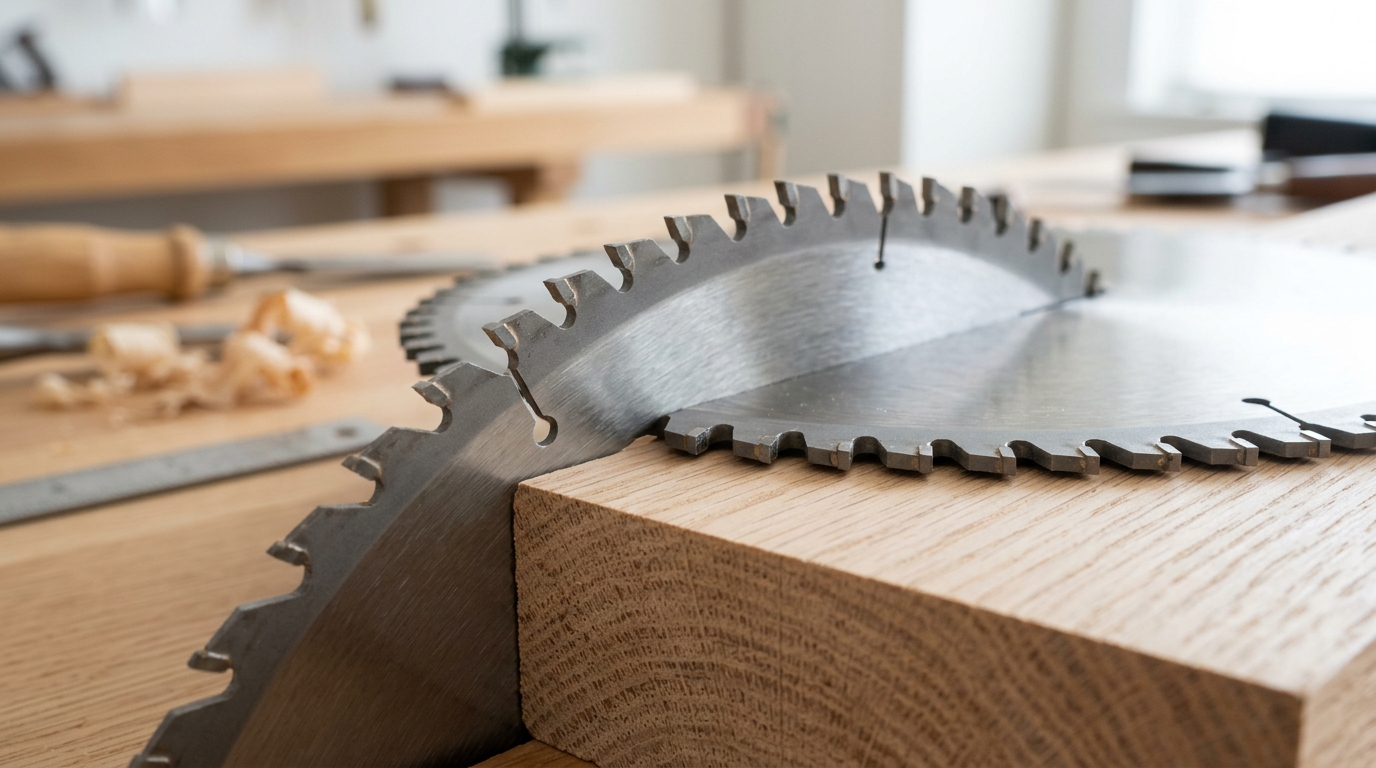
A crosscut saw blade severs wood fibers perpendicular to the grain — think trimming a board to final length or sizing a sheet of plywood. Where a rip blade acts like a series of tiny chisels, a crosscut blade works more like a row of small knives, slicing cleanly through each fiber to prevent tear-out.
Alternate Top Bevel (ATB) Tooth Geometry
The defining feature is the alternate top bevel grind. Each tooth is angled in the opposite direction from its neighbor, typically at 10°–20°. This creates a shearing action that scores both sides of the kerf before removing material, which is exactly why crosscut blades leave edges so smooth.
Higher Tooth Count and Shallower Hook Angles
Expect 60 to 80+ teeth on a standard 10-inch crosscut blade. More teeth mean more contact points per revolution, translating directly into finer surface quality. The hook angle stays shallow — usually 5° to 15° — so the blade doesn’t bite too aggressively into cross-grain fibers. Gullets are correspondingly smaller because each tooth removes less material per pass.
The core difference between rip and crosscut saw blade designs becomes obvious here: a crosscut blade sacrifices feed speed for finish quality, while a rip blade does the opposite.
Typical applications include miter cuts on trim, cutting plywood panels without splintering the veneer face, and any operation where a clean edge matters more than raw speed. For plywood specifically, pairing the right blade with the best cutting tool material for plywood dramatically reduces chip-out. Brands like ZC-TOOLS engineer their crosscut blades with DIN 8037–compliant tips and acoustic-optimized tooth profiles to minimize vibration during these precision cuts.
Key Differences in Tooth Geometry, Hook Angle, and Tooth Count
The most telling difference between rip and crosscut saw blade designs lives in three measurable specs: grind profile, hook angle, and tooth count. Change any one of these, and the blade behaves like an entirely different tool.
Tooth Grind Profiles
Rip blades almost universally use a Flat Top Grind (FTG) — each tooth is squared off like a chisel, ideal for scooping material along the grain. Crosscut blades rely on Alternate Top Bevel (ATB) or Hi-ATB grinds, where alternating teeth are angled at 15°–25° (or 30°+ for Hi-ATB). These angled tips slice fibers cleanly instead of tearing them.
Hook Angle and Feed Rate
Rip blades carry an aggressive positive hook angle — typically 18° to 22° — pulling stock into the blade for faster feed rates. Crosscut blades sit between 5° and 15°, slowing the bite to prevent tearout. A negative hook angle (common on sliding miter saw blades) slows feed even further for ultra-clean results.
Tooth Count, Gullet Size, and Kerf
Fewer teeth mean larger gullets and faster chip clearance — exactly what ripping demands. More teeth produce a finer finish but generate more heat. Kerf width matters too: a full-kerf rip blade (around 1/8″) removes more material but requires more motor power, while thin-kerf crosscut blades reduce waste on expensive hardwoods.
| Specification | Rip Blade | Crosscut Blade |
|---|---|---|
| Tooth Grind | FTG | ATB / Hi-ATB |
| Hook Angle | 18°–22° | 5°–15° |
| Tooth Count (10″) | 24–30 | 60–80 |
| Gullet Size | Large | Small |
| Typical Kerf | ~1/8″ (full) | ~3/32″ (thin) |
| Best Finish | Rough (needs jointing) | Smooth, minimal sanding |
Quality blades from manufacturers like ZC-TOOLS — which use German substrates and Luxembourg carbide tips compliant with DIN 8037 — hold these geometries longer, so the difference between rip and crosscut performance stays consistent across hundreds of cuts. For a broader look at blade and tool selection, see our industrial woodworking cutting tools buyer’s guide.
What Happens When You Use the Wrong Blade for the Cut
Understanding the difference between rip and crosscut saw blade designs isn’t academic — it has immediate, tangible consequences at the table saw. Mismatching blade to cut direction degrades your workpiece, stresses your equipment, and can put you in danger.
Rip Blade on a Crosscut: Tearout and Splintering
A rip blade’s flat-top teeth and aggressive hook angle are designed to chisel along the grain. Force those same teeth across the grain, and they rip fibers apart instead of severing them cleanly. The result? Ragged exit tearout, fuzzy edges, and splintering that no amount of sanding fully repairs. On veneered plywood or melamine, the damage is even worse — expect visible chip-out along the entire cut line.
Crosscut Blade on a Rip Cut: Burning, Overheating, and Kickback Risk
This mismatch is more dangerous. A crosscut blade’s high tooth count and shallow hook angle create excessive friction during long rip cuts. Watch for these warning signs:
- Burn marks — dark scorch lines on the wood edge
- Slow feed rate — you’re pushing harder than normal
- Blade heat — the plate warps slightly, causing the cut to wander
- Kickback potential — a binding blade can launch the workpiece back at you
If you smell burning wood or feel unusual resistance mid-cut, stop immediately. That’s your clearest signal the blade doesn’t match the task.
Investing in purpose-built blades — like ZC-TOOLS precision saw blades engineered with optimized tooth geometry — eliminates these problems and extends blade life significantly. For a broader look at selecting the right cutting tools, see our guide to essential woodworking cutting tools every beginner should own.
Are Combination Blades a Good Alternative to Dedicated Rip and Crosscut Blades
Combination blades — typically 40 to 50 teeth with an ATBR (Alternate Top Bevel plus Raker) tooth configuration — try to split the difference between rip and crosscut saw blade designs. The ATBR pattern groups four ATB teeth for cross-grain shearing followed by one flat-top raker tooth for clearing material along the grain. It’s a genuine compromise, not a gimmick.
For hobbyists running a single table saw in a garage shop, a quality 40-tooth combo blade handles both ripping and crosscutting without constant blade swaps. On a job site where speed matters more than glass-smooth edges, that convenience is hard to beat.
But compromise cuts both ways. A combo blade rips roughly 15–20% slower than a dedicated 24-tooth rip blade, and its crosscut finish on hardwoods like maple or cherry rarely matches what a 60- or 80-tooth crosscut blade delivers. Production shops processing hundreds of linear feet daily feel that gap in both cycle time and sanding labor.
If you’re running dedicated machines — one for ripping, one for crosscutting — purpose-built blades from a quality manufacturer like ZC-TOOLS will outperform any combo blade in cut quality, feed rate, and edge life.
The real question isn’t whether combo blades work. They do. The question is whether “good enough” matches your tolerance for tear-out and your production volume. For a deeper look at choosing tooling that fits your skill level and workflow, see our guide to essential woodworking cutting tools every beginner should own.
How to Choose the Right Blade for Your Project
Knowing the difference between rip and crosscut saw blade designs only matters if you act on it. Here’s a quick decision checklist that pulls everything together.
Ask These Four Questions Before Every Cut
- What direction am I cutting relative to the grain? Parallel = rip blade. Perpendicular = crosscut blade. Mixed or unknown = combination blade.
- What material is on the table? Solid hardwood like oak or maple demands a dedicated blade — a 24-tooth rip for ripping, an 80-tooth crosscut for trim cuts. Plywood and MDF are best served by a high-tooth-count crosscut or a specialized panel blade; check our guide on the best cutting tool material for MDF for specifics.
- Which saw am I using? Table saws handle both rip and crosscut blades well. Miter saws almost always need a crosscut blade — you’re rarely ripping on a miter saw. Circular saws benefit from matching the blade to the dominant cut type of the job.
- How much cutting volume is involved? High-volume production shops should invest in dedicated rip and crosscut blades — the efficiency gains and cleaner edges pay for themselves fast. Weekend projects? A quality 40-tooth combination blade covers 80% of tasks.
Pro tip: If you’re processing sheet goods all day, a 60- to 80-tooth blade with ATB grind outperforms a general combo blade every time. For industrial-grade options, ZC-TOOLS’ saw blade series offers DIN 8037–compliant blades built on German substrates — serious tooling for serious shops.
Stop guessing. Match the blade to the grain direction, the material, and the saw — and the difference between rip and crosscut saw blade performance becomes obvious in every cut you make.
Frequently Asked Questions About Rip and Crosscut Saw Blades
Can I use a crosscut blade on a table saw for ripping? Technically, yes — but expect slow feed rates, excessive heat, and a higher risk of kickback. A crosscut blade’s high tooth count creates too much friction when cutting with the grain. For safe, efficient ripping, switch to a dedicated rip blade.
How many teeth is best for ripping vs. crosscutting? For a standard 10-inch blade, 24 teeth is the sweet spot for ripping, while 60–80 teeth delivers clean crosscuts. This tooth count is central to the difference between rip and crosscut saw blade performance.
Does blade diameter change whether it’s a rip or crosscut blade? No. Diameter affects depth of cut, not function. A 12-inch blade can be either type — tooth geometry and count determine the cutting purpose.
What does ATB vs. FTG mean? ATB (Alternate Top Bevel) teeth shear wood fibers cleanly, ideal for crosscuts. FTG (Flat Top Grind) teeth chisel material out like tiny chisels, perfect for ripping. Some combination blades use ATBR, mixing both profiles.
How often should I sharpen or replace each blade type? Carbide-tipped blades typically last 12–18 months under regular shop use before needing sharpening. Rip blades dull faster because they remove more material per tooth. Quality matters here — ZC-TOOLS saw blades use Luxembourg alloy tips that hold an edge significantly longer than budget alternatives. For a broader look at reliable blade and tool brands, check out our guide to top woodworking tool brands.