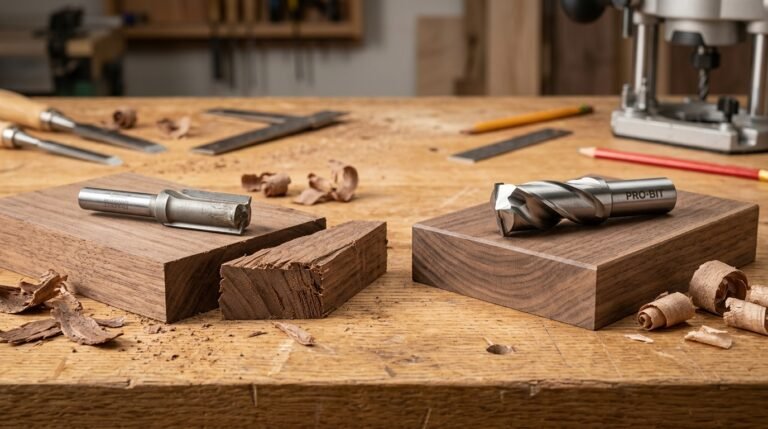
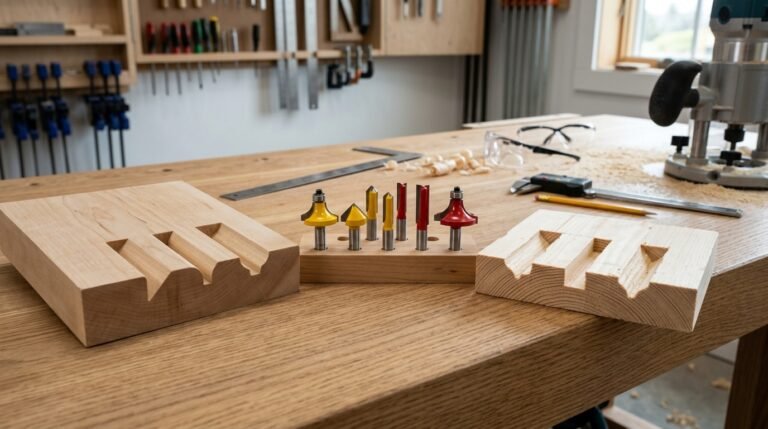
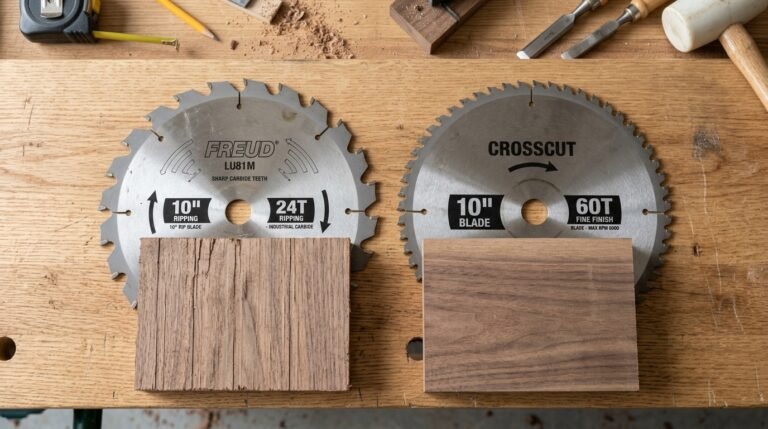
The Forstner bit is like the “finishing tool” of woodworking drilling. Unlike common pointed drill bits, it cuts using the sharp steel rim on the outer edge, producing a perfectly flat hole bottom and smooth, burr-free walls.
Because of this feature, it’s most often used for installing concealed cabinet hinges or drilling blind holes that don’t go all the way through. It also has a special trick: it can drill a half-circle along the edge of a board or overlap an existing hole without slipping.
However, Forstner bits require more force and generate heat quickly, so it’s best to use them with a drill press rather than a handheld drill, which is hard to stabilize. While working, lift the bit occasionally to clear wood chips—otherwise, excessive heat can scorch the wood and cause the bit to lose its sharpness.
Compared to Other Woodworking Drill Bits:
| Bit Type | Bottom Shape | Edge Quality | Best Use Case | Main Drawbacks |
| Forstner Bit | Flat | Excellent (Clean) | Concealed hinges, overlapping holes, fine furniture | Expensive, runs hot, requires a drill press |
| Brad Point Bit | Pointed (W-shape) | Good | Clean through-holes, precise dowel alignment | Cannot drill flat-bottomed holes |
| Spade Bit | Pointed & Rough | Poor (Splinters) | Rough construction, running wires, speed over looks | Very messy edges, high vibration |
| Hole Saw | Hollow (No bottom) | Average | Large diameter through-holes, installing door locks | Cannot drill blind (partial) holes |
| Twist Bit | Conical (V-shape) | Fair | Small pilot holes, general purpose drilling | Wanders in wood, leaves a messy exit |
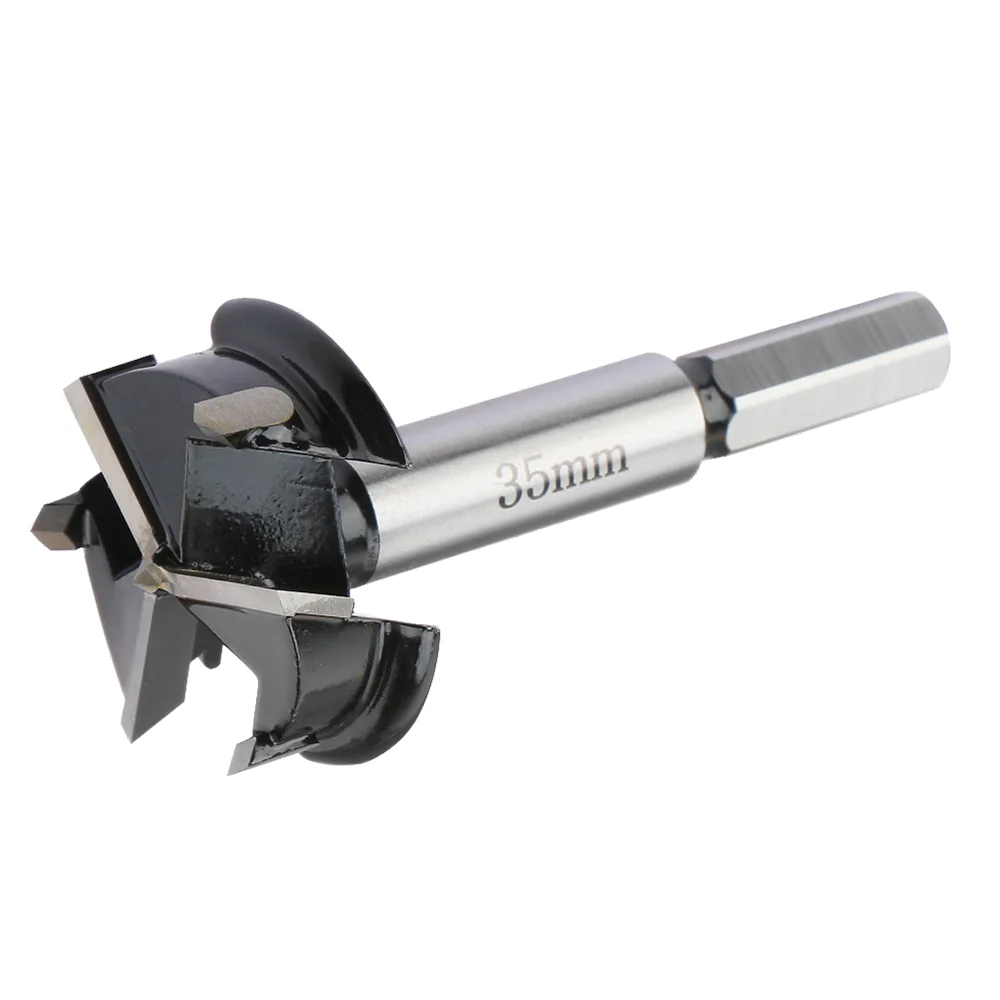
35mm-3-Flute-TCT-Forstner-Bit-for-Woodworking
Key Features of a Forstner Bit
The Forstner Bit is a highly practical and “hardcore” tool in woodworking. If you value precision and clean results, it’s an essential choice.
What makes this bit special can be summarized in the following key aspects:
1. Perfectly Flat Hole Bottom
Unlike ordinary twist bits that produce pointed bottoms, a Forstner bit creates clean, perfectly flat holes. This is especially important when installing concealed hinges, such as cup hinges.
2. Extremely Clean Edge Cutting
The bit works using the cutting rim along its circumference. As it enters the wood surface, it produces smooth, tear-free edges, ensuring the hole perimeter is perfectly clean.
3. Overlapping and Angled Drilling
-
Overlapping Holes: You can remove material next to an existing hole without the misalignment issues common with standard bits.
-
Angled Holes: It can start drilling directly on a sloped surface without slipping.
4. Precise Hole Positioning
A small center spur provides accurate positioning. Although it has a center point, most of the cutting force is concentrated on the outer rim, maintaining excellent stability during drilling.
Precautions: Since this bit has a large contact area with the wood, it generates significant friction. It is recommended to use a drill press at a relatively low speed to prevent scorching the wood or tempering the bit.
How Does a Forstner Bit Work?
The working principle of a Forstner Bit can be summarized as “score first, remove material second.” Unlike ordinary bits that rely on the center point to “drill through,” it works through a combination of outer rim guidance and bottom cutting.
Here are the three core steps of its operation:
1. Center Positioning
The bit features a small center spur. Much like the pivot point of a compass, it pierces the wood first to ensure the bit doesn’t “walk” or wander, locking in the exact center of your hole.
2. Perimeter Scoring
As the bit rotates, the sharp outer rim (peripheral edge) contacts the wood first.
-
It acts like a circular knife, slicing the wood fibers around the circumference before the main lifting begins.
-
This is why the edges are so clean—the fibers are severed cleanly rather than being torn upward.
3. Flat Shaving (Paring)
Once the perimeter is defined, the two main lifter cutters (radial blades) at the bottom go to work.
-
These act like high-speed hand planes, shaving the wood away in flat layers inside the scored circle.
-
This horizontal shearing action is what creates the signature perfectly flat bottom.
Why is it superior?
-
Rim-Guided Stability: Because it is guided by its edge rather than its center, you can use it to drill overlapping holes or even holes at the edge of a board where the center spur has no wood to bite into.
-
Chip Management: Since it lacks the long spiral flutes of a twist bit, it doesn’t eject chips as efficiently. When drilling deep, you should occasionally lift the bit to clear out the shavings and prevent heat buildup.
How Is a Forstner Bit Made?
A Forstner bit is precision-machined into shape and then heat-treated to ensure the cutting edges stay sharp and resist deformation during heavy-duty woodworking.
1. Material Selection and Machining
The process begins with high-quality high-carbon steel or high-speed steel (HSS) round bars.
-
Roughing: A CNC lathe machines the steel bar into the general shape of the bit, defining the shank and the head profile.
-
Precision Milling: This is the most critical step. High-precision milling machines carve out the bit’s core features: the Center Spur, the Outer Rim (peripheral edge), and the Internal Lifters (cutting blades).
2. Heat Treatment
To ensure the bit is hard enough to cut through hardwoods without dulling quickly, it must undergo heat treatment:
-
Quenching: The bit is heated to an extremely high temperature and then cooled rapidly to increase hardness.
-
Tempering: It is heated again at a lower temperature to reduce brittleness, giving the bit toughness while maintaining its edge.
3. Grinding and Sharpening
After heat treatment, the bit undergoes final precision grinding:
-
Sharpening: Industrial diamond grinding wheels sharpen the cutting edges to a razor-sharp finish.
-
Polishing: The surfaces are polished to remove burrs, which helps with smoother chip ejection during drilling.
4. Coating and Inspection
-
Surface Treatment: Many modern bits receive a PTFE (Teflon) or Titanium Nitride (TiN) coating to reduce friction and prevent overheating.
-
Quality Control: The bits are inspected for concentricity to ensure they rotate perfectly without wobbling.
Summary of the Core Principle: Unlike a standard twist drill that “bores” its way in, a Forstner bit acts more like a “circular chisel.” The outer rim shears the wood fibers first, and then the internal blades plane the wood away like a hand plane, resulting in a perfectly smooth, flat-bottomed hole.
Types of Forstner Bits
Forstner bits are categorized into several types based on their design and intended use. The most common is the continuous rim bit, which provides maximum guidance and the smoothest hole walls, making it ideal for precision work with a drill press.
For handheld drilling or larger diameters, the wavy-edged or multi-spur bit is more effective because the serrated teeth reduce friction heat and speed up chip removal.
There is also the carbide-tipped bit, which features hardened alloy cutters welded to the edges specifically for boring into extremely hard or abrasive materials like particle board and laminates, offering much longer tool life despite the higher cost.
| Type of Forstner Bit | Description | Key Features | Advantages | Disadvantages |
|---|---|---|---|---|
| Standard / Continuous Rim | Original design with continuous circular rim | Extremely high cutting precision, very smooth hole walls | Smooth finish, high accuracy | Slow heat dissipation, slower drilling speed |
| Wavy Edge / Serrated Edge | Rim has wavy or serrated edges | Reduced contact area, less friction, better heat dissipation | Faster drilling, less risk of scorching, longer lifespan | — |
| Adjustable Forstner Bits | Cutting wings can move and lock at different radii | One bit covers multiple diameters (e.g., 1″–3″) | Versatile, reduces need for multiple bits | Less stable than fixed-size bits, slightly unbalanced |
| Tipped / Carbide-Tipped | Cutting edges tipped with carbide | Extremely hard and wear-resistant | Long lifespan, handles tough materials | More expensive |
| Extension / Long Shank Bits | Extended shank connects to standard bit | Reach deeper or through thick boards | Drill deep holes or thick boards | Requires stable setup |
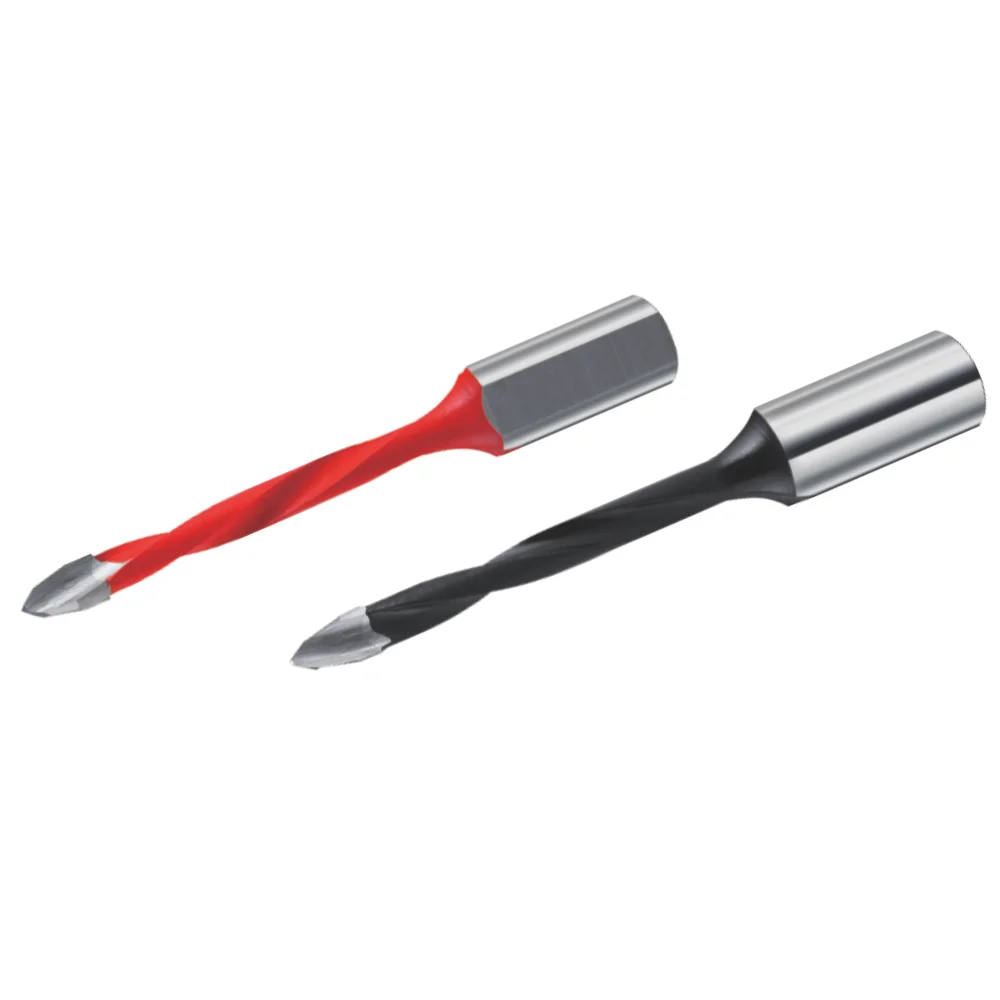
European-style Forstner Bit – Precision Drilling, Durable Design
Benefits of Using Forstner Bits
Forstner bits hold an irreplaceable advantage over twist bits or spade bits because they are guided by their outer rim rather than just a center point. While ordinary bits rely entirely on the center tip for positioning—which often leads to drifting when hitting uneven grain or drilling overlapping holes—the Forstner bit works differently.
As it cuts, its sharp outer edge shears into the wood first to create a stable circular track that acts like a built-in guide rail. This design allows the bit to resist lateral pressure and maintain a precise, vertical hole even if the center point is not fully engaged in the material.
1. Perfectly Flat Bottoms
This is their greatest advantage. They produce holes with a very flat base (except for a tiny dimple created by the center spur).
-
Best for: Installing cup hinges (concealed hinges), countersinking bolts, or inlaying coins and dowels.
2. Clean and Tear-free Edges
The outer rim of a Forstner bit acts like a knife, shearing the wood fibers around the perimeter before the inner lifters remove the waste.
-
Benefit: This results in “splinter-free” holes with razor-sharp edges on the entry surface.
3. Ability to Drill Overlapping or Partial Holes
Because the bit is guided by its outer edge rather than the center point, it remains stable even if the center point isn’t in contact with the wood.
-
Best for: Drilling semi-circular notches on the edge of a board or creating a series of overlapping holes to clear out a mortise.
4. Superior Directional Control
Standard bits often drift when they encounter uneven grain or knots. The large surface area of the Forstner bit’s rim provides excellent guidance.
-
Benefit: It allows for precise drilling of angled holes (pocket holes) without the bit “walking” or slipping.
5. Ideal for Large Diameter Holes
When you need to drill large holes (e.g., over 35mm), Forstner bits are much more stable and safer than spade bits and produce much cleaner results than hole saws.
What Is a Forstner Bit Used For?
In fact, whenever you need a large-diameter hole with extremely clean edges, an absolutely flat bottom, or high positional accuracy, a Forstner bit is the essential tool for the job.
| Core Use Case | Specific Application | Why Use a Forstner Bit? |
| Hinge Installation | Installing concealed cabinet hinges (e.g., 35mm cup hinges). | Creates a flat-bottomed hole at a precise depth. |
| Inlays & Recesses | Embedding coins, magnets, or decorative dowels. | The flat base allows the object to sit flush against the bottom. |
| Edge Drilling | Creating semi-circular notches on the edge of a board. | Guided by the rim, so it won’t slip even if the center is off the wood. |
| Overlapping Holes | Removing waste material for a mortise (slot). | Stays stable even when drilling into an existing hole. |
| Angled Holes | Entering the wood at a 45-degree or custom angle. | The sharp rim bites into the wood immediately to prevent “walking.” |
| Fine Finish Work | Drilling into veneers or expensive hardwoods. | Shears the fibers first to produce splinter-free edges. |
| Enlarging Holes | Increasing the diameter of a pre-existing hole. | Provides superior tracking compared to bits guided only by a point. |
How to Use a Forstner Drill Bit?
To get the best from a Forstner bit, you need to use low speeds and lift the bit often to clear chips and heat, while keeping the wood firmly clamped to ensure a precise, flat hole.
1. Equipment Selection
-
Drill Press (Preferred): This is the best way to use a Forstner bit. Since these bits remove a lot of material, a drill press provides stable pressure and perfect vertical alignment.
-
Handheld Drill: If a handheld drill must be used, hold it firmly with both hands and start slowly. Without a long center spur, the bit can easily wander when hand-held.
2. Setting the Speed (RPM)
-
Rule of Thumb: Larger diameter bits require slower speeds.
-
Small Bits (< 25mm): Can run slightly faster (~1000–1500 RPM).
-
Large Bits (> 25mm): Must run slower (~250–500 RPM) to avoid overheating, scorching the wood, or damaging the bit.
3. Operating Steps
-
Positioning: Align the bit’s center spur precisely with the marked point.
-
Step-Feed Drilling: Use a “two steps down, one step up” approach. Drill a short distance, lift the bit to clear chips, then continue downward.
-
Prevent Tear-Out: If drilling through wood, place scrap wood underneath. Alternatively, drill from the front until the center spur just emerges on the back, then flip the workpiece and drill through from the reverse side.
4. Safety and Maintenance
-
Cooling: Stop immediately if the bit feels overloaded or you see smoke.
-
Secure Workpiece: Always clamp your workpiece firmly. The torque from large-diameter bits can otherwise fling the wood dangerously.
Recommended RPM Chart
The general rule for Forstner bits is: The larger the bit, the slower the speed. Using a high speed on a large bit will cause friction, which burns the wood and ruins the bit’s temper (sharpness).
| Bit Diameter (Inches/mm) | Softwood (Pine, Cedar) | Hardwood (Oak, Walnut) |
| 1/4″ – 3/8″ (6-10mm) | 2400 RPM | 500 – 700 RPM |
| 1/2″ – 5/8″ (12-16mm) | 1500 RPM | 500 – 700 RPM |
| 3/4″ – 7/8″ (19-22mm) | 1000 RPM | 400 – 600 RPM |
| 1″ – 1-1/8″ (25-28mm) | 750 RPM | 400 – 600 RPM |
| 1-1/4″ – 1-1/2″ (32-38mm) | 500 RPM | 250 – 400 RPM |
| 2″ + (50mm+ ) | 250 RPM | 150 – 250 RPM |
Pro Tips for Success
-
Use a Drill Press: Whenever possible, use a drill press. Forstner bits require significant downward pressure and must stay perfectly vertical. If using a handheld drill, go slowly and use both hands to maintain control.
-
Clear the Chips: These bits generate a lot of waste. Use a “peck drilling” technique—drill down about 1/4 inch, pull the bit up to clear the wood chips, and then go back down. This prevents heat buildup.
-
Prevent “Blowout”:
-
Backer Board: Clamp a piece of scrap wood underneath your workpiece to ensure a clean exit hole.
-
The Two-Side Method: Drill from the front until the center spur (the tiny point) just pokes through the back. Flip the board over and finish the hole from the other side.
-
-
Identify Overheating: If you see smoke or the wood turns black (burn marks), your RPM is too high or you are not clearing chips fast enough. Stop immediately to let the bit cool down.
Where to Buy Forstner Bits in Bulk?
If you are looking for a reliable source for Bulk Forstner Bits, ZC Tools is a top-tier professional choice. As a leading Chinese forstner bits manufacturer with 25 years of expertise, they specialize in high-performance woodworking cutting tools.
Here is why you should buy from ZC Tools:
1. Direct Factory Wholesale Pricing
As a source manufacturer located in Shunde, Foshan, ZC Tools eliminates middlemen, offering:
-
Competitive Bulk Rates: Specifically designed for global distributors and large-scale furniture factories.
-
OEM/ODM Support: Ability to customize sizes, coatings, and shank specifications to meet your brand’s needs.
2. Industrial-Grade Quality
ZC Tools’ Forstner Bits are engineered for demanding environments:
-
Premium Materials: Made with high-hardness TCT (Tungsten Carbide Tipped) or HSS, ensuring clean, flat-bottomed holes in MDF, plywood, and solid wood.
-
Precision Engineering: Features a unique cutting-edge design that minimizes heat buildup and prevents wood burning.
-
Extended Lifespan: Users report up to 2× longer service life compared to standard retail bits.
3. Comprehensive Product Range
In addition to Forstner Bits, you can consolidate your supply chain by sourcing other essential tools in bulk:
-
Hinge Boring Bits (for CNC and hinge machines)
-
Brad Point Bits (for precision line boring)
-
TCT Saw Blades & CNC End Mills
4. How to Contact ZC Tools for a Quote
You can reach out directly to their management team to request a Price Catalogue or a bulk discount:
-
Contact Person: Judy (Manager)
-
Phone/WhatsApp: +86 13924849944
-
Email: zctools99@163.com
-
Address: 6F, Building 2, Shunheli Kechuang Park, Shunde District, Foshan, Guangdong, China.
Pro Tip: When inquiring about Bulk Procurement, it is recommended to specify your application scenarios (e.g., the specific type of wood or material you are processing) and your annual volume requirements. This information allows Judy’s team to provide more precise tool recommendations and offer you a more competitive discount.
Faq
Can a forstner bit be used in a hand drill?
Yes, you can use a Forstner bit with a hand drill, but it is challenging to keep stable and is much safer and more precise when used in a drill press.
Can a forstner bit drill aluminum?
Standard Forstner bits are designed strictly for wood and should not be used to drill aluminum, as the metal will quickly dull the cutting edges and could cause the bit to kick back.
Can forstner bits be sharpened?
Yes, Forstner bits can be sharpened using a small diamond file or whetstone on the internal cutting edges and spurs to restore their performance.