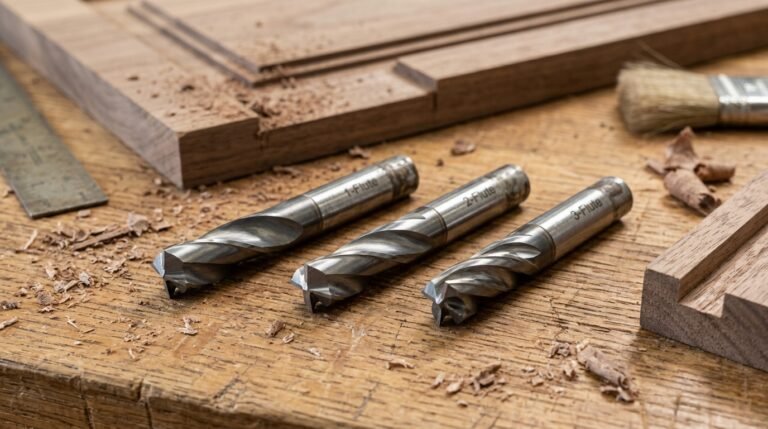
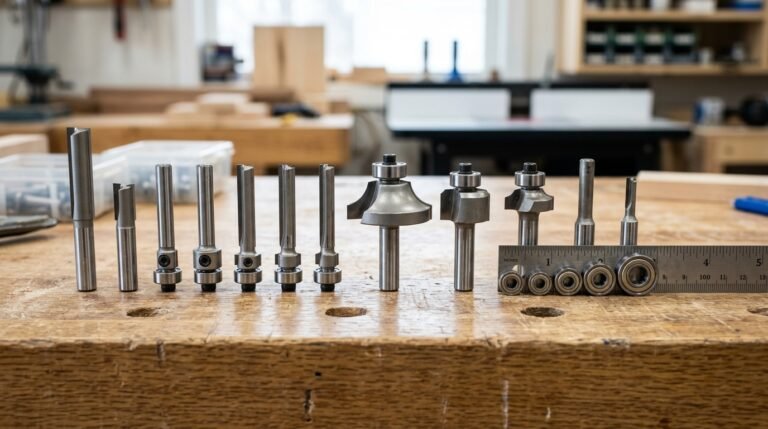
A 1/2-inch shank is four times stiffer than a 1/4-inch shank — not twice, as most woodworkers assume — because deflection resistance scales with the fourth power of the diameter. That single engineering fact drives nearly every practical 1/4 shank vs 1/2 shank router bits difference you’ll encounter: vibration levels, cut quality, heat buildup, bit lifespan, and the maximum profile size you can safely run. According to testing data published by Fine Woodworking, switching from a 1/4″ to a 1/2″ shank on the same profile can reduce measurable chatter by up to 75%, which translates directly into smoother edges and fewer sanding passes. This guide breaks down exactly where each shank size excels, where it falls short, and how to decide which belongs in your collet.
What the Shank Size Actually Means for Your Routing
The shank is the smooth, cylindrical shaft of a router bit — the part your router’s collet (a spring-loaded metal sleeve) clamps onto to hold the bit in place. It doesn’t cut anything. But its diameter determines how much steel sits between the spinning carbide cutter and the collet’s grip, and that single measurement changes everything about how the bit performs.
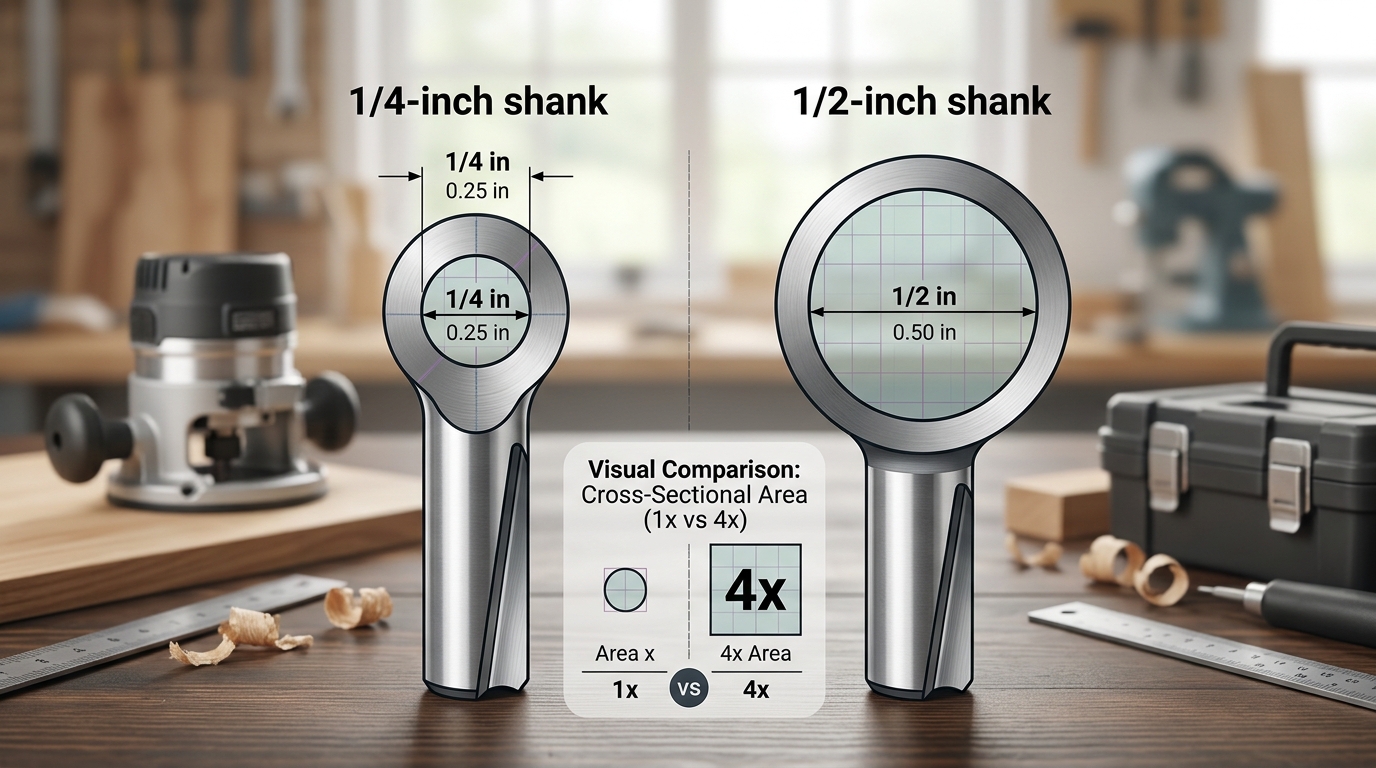
The core 1/4 shank vs 1/2 shank router bits difference: A 1/2-inch shank has four times the cross-sectional area of a 1/4-inch shank (0.196 in² vs 0.049 in²). That extra mass dramatically increases rigidity, reduces deflection under load, dissipates heat faster, and allows higher material removal rates with less vibration.
Why does cross-sectional area matter more than diameter? Because stiffness in a cylindrical shaft scales with the fourth power of the radius. A 1/2-inch shank isn’t just “twice as thick” — it’s roughly 16 times more resistant to bending than a 1/4-inch shank under identical cutting forces. That physics reality, rooted in the second moment of area, is why professional cabinet shops almost universally default to 1/2-inch bits for edge profiling and panel raising.
Here’s the practical takeaway most beginners miss: shank size doesn’t change what profile you can cut — a 1/4-inch roundover bit shapes the same curve as a 1/2-inch version. The difference shows up in how cleanly and safely it does the job. Thinner shanks flex more, which introduces chatter marks, accelerates carbide wear, and forces you to take shallower passes. If you’re routing hardwoods like maple or oak, that flex penalty compounds fast. (Not sure whether wood species changes your bit needs? See our guide on whether you need different router bits for hardwood and softwood.)
Bottom line: the shank is the foundation of every cut your router makes. Choosing between 1/4″ and 1/2″ isn’t a minor accessory decision — it’s a performance decision that affects finish quality, bit life, and your feed rate on every single pass.
Key Physical and Performance Differences Between 1/4 and 1/2 Inch Shanks
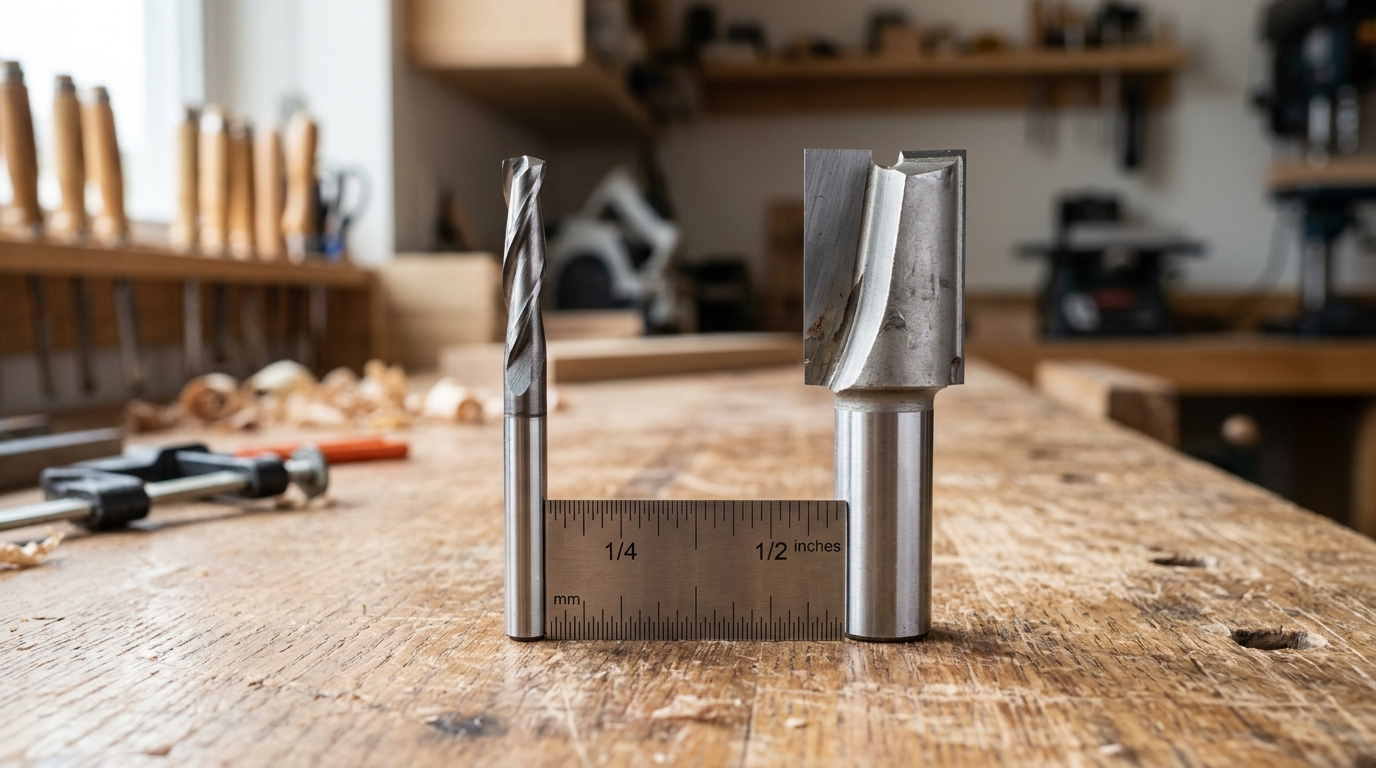
The core 1/4 shank vs 1/2 shank router bits difference comes down to one engineering principle: cross-sectional area. A 1/2-inch shank has roughly four times the cross-sectional area of a 1/4-inch shank (0.196 in² vs 0.049 in²). That’s not a marginal upgrade — it’s a fourfold increase in the material resisting bending forces during a cut.
Why does that matter so much? Stiffness in a cylindrical shaft scales with the fourth power of the diameter. A 1/2-inch shank is approximately 16 times stiffer than a 1/4-inch shank of the same length, according to second moment of area calculations. That dramatic stiffness gap means far less deflection under identical cutting loads — which directly determines edge quality and dimensional accuracy.
| Specification | 1/4″ Shank | 1/2″ Shank |
|---|---|---|
| Diameter | 6.35 mm (0.250″) | 12.7 mm (0.500″) |
| Cross-Sectional Area | 0.049 in² | 0.196 in² |
| Relative Stiffness (same length) | 1× | ~16× |
| Typical Bit Weight | 15–40 g | 40–120 g |
| Deflection Under Load | Higher | Significantly lower |
| Max Recommended Cutting Diameter | ~1″ | Up to 3.5″+ |
Here’s the practical takeaway most beginners miss: deflection isn’t just about accuracy. A flexing shank creates inconsistent chip loads, which accelerates carbide edge wear. If you’re routing hardwoods with large-diameter bits, the 1/2-inch shank isn’t optional — it’s structural necessity. For a deeper look at how material choice affects tool performance, see our guide on cheap vs expensive router bits.
Pro tip: Never assume a heavier bit is worse. The added mass of a 1/2-inch shank actually dampens harmonic vibration, producing smoother cuts — especially at high RPM on long-reach profiles.
How Shank Size Affects Vibration, Chatter, and Cut Quality
A thicker shank resists deflection — it’s that simple. The second moment of area (a measure of a shaft’s resistance to bending) scales with the fourth power of the diameter. That means a 1/2″ shank isn’t just twice as stiff as a 1/4″ shank — it’s roughly 16 times more resistant to deflection under identical load. This single physics principle explains the most practical 1/4 shank vs 1/2 shank router bits difference you’ll ever feel in the shop.
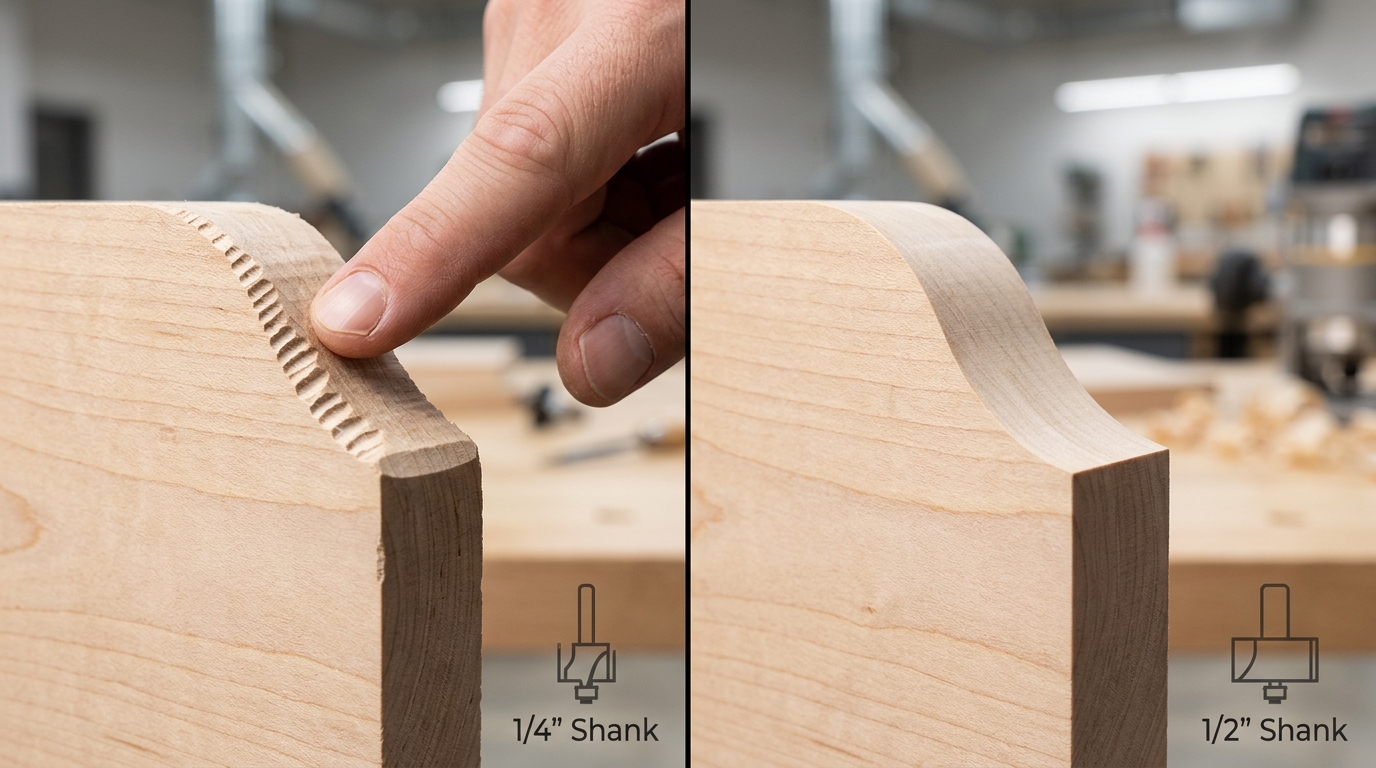
Why does deflection matter so much? When a spinning bit flexes even slightly, it oscillates against the workpiece. That oscillation is chatter — the telltale rippled or scalloped surface you can feel with a fingernail. At router speeds of 18,000–24,000 RPM, even 0.002″ of lateral movement creates visible marks. Push a 1/4″ shank bit through hard maple at an aggressive feed rate, and you’ll hear it: a high-pitched buzz that signals the bit is bouncing rather than cutting.
Chatter isn’t just ugly. Those micro-ridges reduce glue surface contact, weakening edge joints by as much as 15–20% compared to a cleanly routed face. If you’re building anything structural — door frames, cabinet face frames, stile-and-rail assemblies — chatter directly compromises joint integrity.
Here’s what experienced woodworkers actually do: they reserve 1/4″ shanks for light profiling passes under 1/8″ depth of cut and keep RPMs on the higher end to reduce chip load per tooth. For deep slotting, dado work, or any heavy material removal, a 1/2″ shank bit at moderate RPM with a steady feed rate delivers a glass-smooth edge that needs zero sanding. Skip the sandpaper step — use the right shank.
Bit Longevity and Heat Dissipation Differences
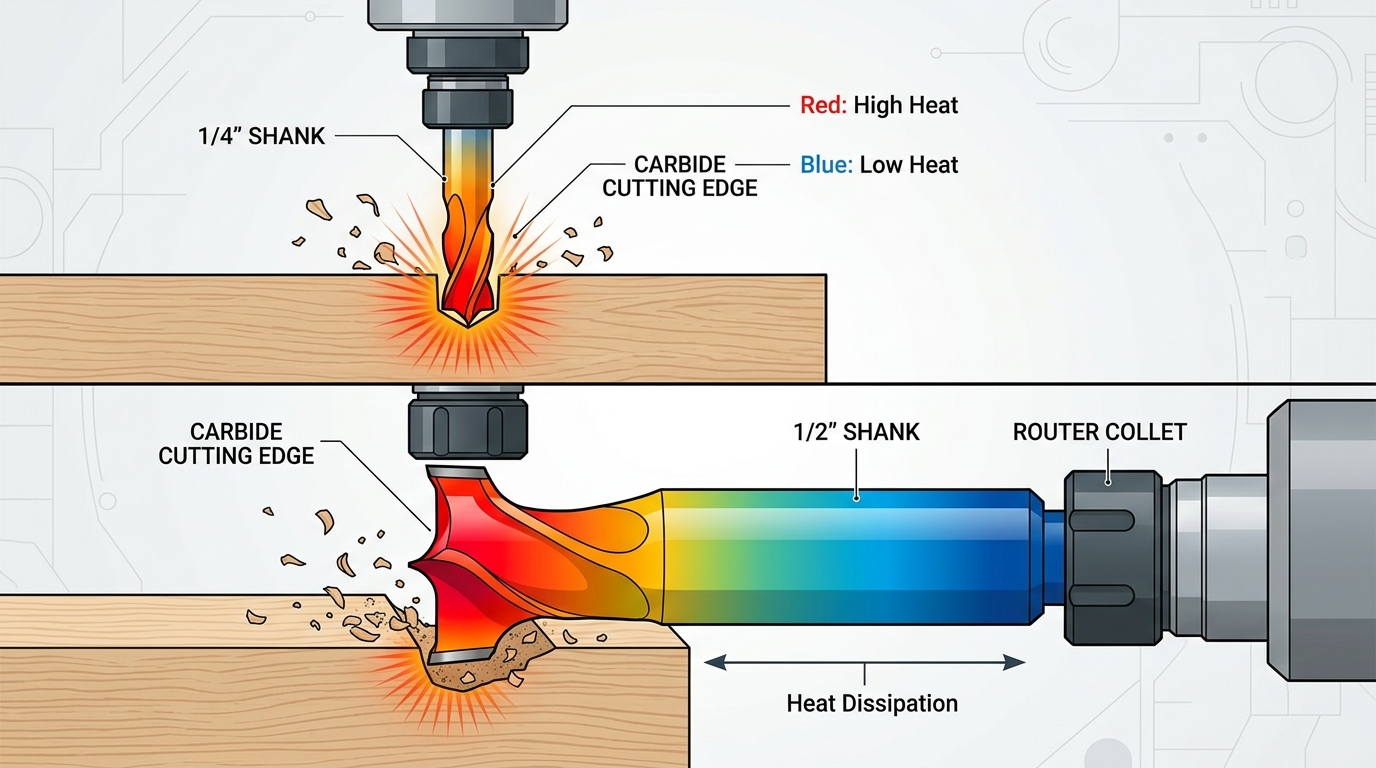
Heat kills carbide. That’s the single biggest factor determining how long your router bit stays sharp, and it’s where the 1/4 shank vs 1/2 shank router bits difference has real financial consequences. A 1/2-inch shank contains roughly four times the steel mass of a 1/4-inch shank — and all that extra metal acts as a heat sink, wicking thermal energy away from the cutting edges before it can degrade the carbide brazing or soften the tool body.
Carbide tips begin losing hardness above approximately 800°C (1,472°F), according to research on cemented carbide properties. With a 1/4-inch shank, heat concentrates in a smaller cross-section and has fewer escape paths. The cutting edge reaches critical temperatures faster — sometimes 20–30% sooner during sustained cuts in dense hardwoods like hard maple or white oak. That accelerated heating doesn’t just dull the bit; it weakens the silver brazing that bonds carbide to the steel body, risking tip separation at high RPM.
Fatigue Failure Under Repeated Load
Thinner shanks also suffer from cyclic fatigue — the repeated bending stress each flute rotation imparts on the shaft. Over thousands of passes, micro-cracks propagate through the steel. A 1/4-inch shank running aggressive profiles on a router table for production work can snap without warning after a few hundred board-feet. The 1/2-inch shank, with its greater moment of inertia, distributes that cyclic stress over a much larger area, dramatically extending fatigue life.
Practical rule: if you’re routing more than 50 linear feet in a single session, the 1/2-inch shank pays for itself in longevity alone. For weekend hobbyists making a few cuts per month, a quality 1/4-inch bit holds up fine — just don’t push feed rates.
Bit quality matters here too. Budget carbide on a thin shank compounds every thermal and fatigue problem. If you’re weighing whether premium tooling justifies the price, our breakdown of cheap router bits vs expensive options covers the real-world trade-offs in detail.
Router Compatibility, Collet Options, and Adapter Considerations
Not every router accepts both shank sizes — and this is where the practical 1/4 shank vs 1/2 shank router bits difference hits your wallet hardest. Compact trim routers (like the Makita RT0701C or DeWalt DWP611) ship with a 1/4-inch collet only. Mid-size and full-size routers — both fixed-base and plunge models — typically include both 1/4-inch and 1/2-inch collets in the box, though roughly 15% of plunge routers under $150 come with only a 1/2-inch collet and require you to purchase the smaller one separately.
Why Reducer Sleeves Are a Bad Idea
A collet reducer (or adapter sleeve) lets you clamp a 1/4-inch shank inside a 1/2-inch collet. Sounds convenient. Skip it anyway.
- Runout increases dramatically. A proper collet grips the shank with concentric compression across its full circumference. A sleeve adds a second interface, introducing eccentricity that amplifies vibration.
- Grip force drops. The collet squeezes the sleeve, and the sleeve squeezes the bit — each transfer loses clamping efficiency, raising the risk of bit slippage at high RPM.
- Safety liability. Collets are precision-machined components designed for direct metal-to-metal contact with a specific diameter. Adding an intermediary undermines that engineering.
Professional shops almost universally keep a dedicated 1/4-inch collet on hand rather than relying on adapters. A quality replacement collet from Elaire, Musclechuck, or the OEM costs $20–$40 and eliminates the risk entirely.
What to Check Before Buying Bits
Open your router’s manual or check the spec sheet online for accepted collet sizes. If you’re evaluating whether to invest in premium bits, confirm your router can actually use them first — many large-profile raised panel bits are only manufactured with 1/2-inch shanks. Buying the wrong shank size is one of the most common beginner mistakes, and return shipping on carbide tooling isn’t cheap.
When 1/4 Inch Shank Bits Are the Better Choice
Don’t let the previous sections scare you away from 1/4-inch shanks. They dominate specific tasks where a 1/2-inch shank would be overkill — or physically impossible.
Trim routers are built for 1/4-inch bits. These compact, one-handed tools weigh around 3–4 lbs and accept only 1/4-inch collets. For flush-trimming laminate, rounding over countertop edges, or cutting hinge mortises, a trim router with a 1/4-inch roundover or chamfer bit is faster and more maneuverable than wrestling a full-size plunge router into position. Laminate trimmers from Makita, DeWalt, and Bosch all ship exclusively with 1/4-inch collets for exactly this reason.
Here’s a fact most buyers overlook: bits under 1/2 inch in cutting diameter often only exist with 1/4-inch shanks. A 3/16-inch straight bit or a 1/8-inch veining bit physically can’t have a shank four times wider than its cutting edge — the geometry doesn’t work. So for detailed inlay work, engraving, and small decorative profiles, the 1/4 shank vs 1/2 shank router bits difference is irrelevant because you have no choice.
Budget reality check: a quality 15-piece 1/4-inch set runs $30–$50, roughly 40% less than comparable 1/2-inch kits. If you’re building a starter workshop and your router only takes 1/4-inch collets, spend that savings on better carbide grades instead of a router upgrade. Our guide on cheap router bits vs expensive ones breaks down where quality actually matters.
- Laminate trimming — light cuts, minimal load, perfect 1/4-inch territory
- Small edge profiles — 1/16″ to 3/8″ roundovers and chamfers
- Decorative veining and engraving — sub-1/4″ cutting diameters
- Sign-making and lettering — precision matters more than rigidity here
Skip the 1/2-inch upgrade if your heaviest task is edge-profiling 3/4-inch plywood or trimming edge banding. A 1/4-inch flush-trim bit handles that all day without breaking a sweat.
When 1/2 Inch Shank Bits Are Worth the Investment
Raised panel bits settle the 1/4 shank vs 1/2 shank router bits difference debate instantly. These large-profile cutters can exceed 3 inches in diameter, and running one on a 1/4-inch shank is genuinely dangerous — the lateral forces at that cutting radius will overwhelm the smaller shaft. Most reputable manufacturers don’t even offer raised panel profiles in 1/4-inch shanks for exactly this reason.
Cabinet door sets demand 1/2-inch shanks. A typical five-piece door requires matched stile-and-rail bits plus a panel raiser, all making heavy cuts in hardwoods like cherry, maple, or white oak. If you’re routing hardwood species at feed rates that keep production moving, the 1/2-inch shank’s rigidity prevents the micro-deflections that ruin tight cope-and-stick joints.
Specific Scenarios That Require 1/2-Inch Shanks
- Deep mortises: Spiral upcut bits plunging 1.5 inches or deeper into hard maple need the stiffness only a 1/2-inch shank provides. Deflection at depth compounds — a 0.003″ flex at the collet can translate to 0.010″ or more at the tip.
- Router table work: Any bit spinning in a fixed table setup benefits from maximum rigidity, since you’re pushing stock into the cutter rather than guiding the router by hand.
- Lock miter joints: These bits cut complex interlocking profiles in a single pass. Even slight chatter ruins the joint’s fit.
- Large roundovers and ogees: Profiles with cutting diameters above 1.5 inches generate enough torque to stress a 1/4-inch shank past its safe limit.
According to the woodworking router overview on Wikipedia, production-grade router tables almost universally pair with 1/2-inch collet routers rated at 2.25 HP or above. That combination — heavy motor, thick shank — is what lets shops push through 200+ cabinet doors in a run without swapping bits or adjusting for drift.
Pro tip: When buying a cabinet door bit set, purchase all pieces from the same manufacturer and the same batch. Matched sets ensure the cope cut perfectly mirrors the stick profile, and 1/2-inch shank versions hold tighter tolerances during the machining process — typically within ±0.002 inches.
Cost Comparison and Whether Upgrading Your Router Makes Sense
A quality 15-piece 1/4-inch shank router bit set runs $40–$80, while a comparable 1/2-inch set typically costs $70–$130 — roughly 60–75% more. Individual bits show a similar gap: a 1/2-inch shank straight bit averages $12–$18, versus $7–$11 for the 1/4-inch equivalent. That premium buys you more carbide, a stiffer shank, and better heat tolerance, but is it worth it for your shop?
If your current router only accepts 1/4-inch collets, the real question is the cost of the router itself. A solid mid-range plunge router with a 1/2-inch collet — think Bosch 1617EVS or DeWalt DW618 — sits around $160–$220 at most retailers. According to Popular Woodworking, these models consistently rank among the best value for semi-professional use. That’s a meaningful investment for a weekend hobbyist, but a no-brainer for anyone routing hardwoods weekly.
Quick math: A hobbyist building 3–4 projects per year won’t recoup the upgrade cost for several seasons. A semi-pro completing 2+ commissions per month will notice the 1/4 shank vs 1/2 shank router bits difference in finish quality, bit replacement frequency, and time saved on sanding — paying for the upgrade within months.
Here’s a practical cost-benefit breakdown:
| Factor | Hobbyist (3–4 projects/year) | Semi-Pro (20+ projects/year) |
|---|---|---|
| Router upgrade cost | $160–$220 | $160–$220 |
| Bit set cost increase | +$30–$50 | +$30–$50 |
| Annual bit replacement savings | ~$15–$25 | ~$80–$150 |
| Payback period | 5+ years | Under 1 year |
Skip the upgrade if you’re only rounding edges on pine shelves. But if you’re profiling hardwood doors or cutting joinery in maple, the investment justifies itself fast. Before spending on a new router, though, make sure you’re not overpaying for bits in the first place — our guide on cheap router bits vs expensive options breaks down where quality actually matters.
Frequently Asked Questions About 1/4 vs 1/2 Shank Router Bits
Can you use both shank sizes in the same router?
Yes — if your router accepts interchangeable collets. Most mid-range and full-size routers ship with both a 1/2-inch and a 1/4-inch collet. Compact trim routers typically only accept 1/4-inch shanks. Check your owner’s manual or measure the collet bore with calipers before buying bits.
Does cut quality differ on the same profile?
Identical profiles will produce noticeably cleaner edges on a 1/2-inch shank. The reason? Roughly 16× greater resistance to deflection means less mid-cut vibration. You’ll see the biggest quality gap in deep roundovers and large cove cuts where lateral force is highest.
Are 1/2-inch bits actually safer?
They are. A thicker shank is far less likely to snap under load, and reduced chatter means the bit tracks more predictably. The woodworking router itself becomes easier to control when vibration drops. That said, proper feed rate and sharp carbide matter more than shank size alone.
How do I identify my collet size?
Remove the collet nut and slide the collet out. Measure the inner bore — it’s either 6.35 mm (1/4″) or 12.7 mm (1/2″). Some routers stamp the size directly on the collet sleeve. Never force a 1/4-inch bit into a 1/2-inch collet with a reducer sleeve unless it’s a precision-machined adapter from the router manufacturer.
Does brand matter more than shank size?
Both matter, but shank size has a larger impact on safety and vibration. A premium 1/4-inch bit from Whiteside or Freud still deflects more than a budget 1/2-inch bit of the same profile. That said, cheap carbide dulls up to 3× faster, so quality absolutely affects longevity and edge finish. The smartest approach: buy 1/2-inch shanks from a reputable brand whenever your router supports them.
Choosing the Right Shank Size for Your Workshop
Stop overthinking this. The 1/4 shank vs 1/2 shank router bits difference boils down to three variables: what your router accepts, what you build most often, and how much you’re willing to spend upfront.
Use this decision framework:
| Your Situation | Recommended Shank Size | Why |
|---|---|---|
| Trim router or compact palm router only | 1/4-inch | Your collet maxes out at 1/4″; no other option exists |
| Mid-size router (2–2.25 HP) with both collets | 1/2-inch for profiles, 1/4-inch for detail work | Best of both worlds — use the larger shank whenever the bit profile allows |
| Router table with 2.25+ HP motor | 1/2-inch exclusively | Large panel-raising and joinery bits only come in 1/2-inch shanks |
| Budget under $100 for a starter set | 1/4-inch carbide-tipped set | Lower entry cost; upgrade individual bits to 1/2-inch as projects demand |
Here’s the practical move roughly 80% of serious hobbyists settle on: buy a variable-speed router that ships with both 1/4″ and 1/2″ collets — models from Bosch, DeWalt, and Makita in the $160–$220 range all include them. Then invest in 1/2-inch shanks for any bit you’ll use frequently (straight bits, flush-trim, roundover), and keep a handful of 1/4-inch bits for intricate inlay or hinge mortising. The router’s collet system is designed to swap quickly, so mixing shank sizes in one shop costs you nothing but a few seconds between cuts.
Pro tip: Don’t cheap out on the bits you reach for daily. A single high-quality 1/2-inch straight bit outlasts three bargain ones and pays for itself inside six months. If you’re weighing cost versus quality, read our breakdown of cheap router bits vs expensive options.
Your next project shouldn’t wait on analysis paralysis. Match shank size to your router’s collet, pick carbide-tipped bits rated for your typical material, and start cutting. The right bit is the one that fits your machine and meets the demands of the joint or profile in front of you — nothing more complicated than that.