A single premium carbide-tipped straight bit can cost $25–$45, while a 30-piece budget set from Amazon often sells for under $30 total — less than a dollar per bit. That price gap raises an obvious question: are cheap router bits vs expensive ones actually worth it, or are you just paying for a brand name? The short answer is that expensive bits almost always deliver cleaner cuts, last significantly longer, and run safer — but cheap bits aren’t universally terrible, and knowing exactly when to spend and when to save can keep hundreds of dollars in your pocket without sacrificing your project quality.
The Short Answer on Cheap vs Expensive Router Bits
Yes, expensive router bits are worth it — but not always. That’s the honest answer most woodworkers arrive at after burning through a few budget sets and finally upgrading. The real question isn’t whether to buy cheap router bits vs expensive ones; it’s knowing exactly when each makes sense.
Spend more when: you’re routing hardwoods, making visible joinery, running the same profile repeatedly, or doing any production work. A $35 Whiteside or CMT spiral upcut bit will outlast five $7 no-name equivalents and deliver cleaner edges on every single pass.
Go budget when: you need a one-off profile you’ll rarely use again, you’re a beginner still learning feed rate and depth control, or you’re cutting MDF and softwoods where finish quality is less critical. A $12 Yonico or KOWOOD roundover bit handles those jobs just fine.
A quick rule of thumb: if the bit touches a surface your customer (or you) will see and feel, invest in carbide quality. If it’s hidden joinery or shop jigs, save your money.
The price gap typically comes down to carbide grade, brazing quality, and manufacturing tolerances — factors we’ll break down section by section below. Material choice matters too; if you’re working across species, understanding whether you need different router bits for hardwood and softwood will sharpen your buying decisions even further.
What Actually Makes a Router Bit Expensive
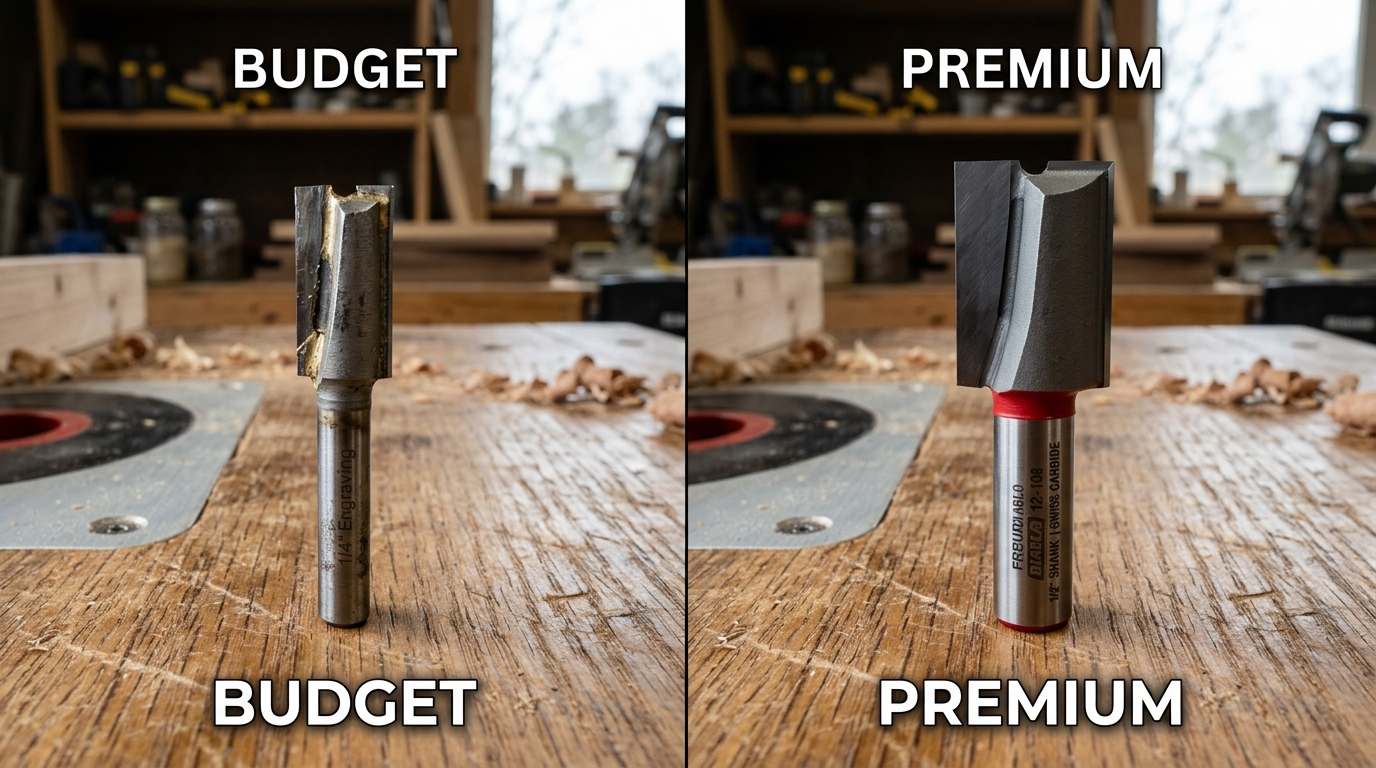
Two bits sit side by side on a shelf, identical profiles, identical shank diameters — yet one costs $5 and the other $35. The difference isn’t marketing. It’s hidden inside the tool itself.
Carbide grade and thickness account for the biggest price gap. Budget bits typically use C2 carbide (a general-purpose grade) brazed in thin strips, sometimes just 1mm thick. Premium bits use micro-grain C4 carbide — harder, more impact-resistant — at 2–3mm thickness. That extra material means more resharpening cycles and significantly longer edge retention, especially when cutting dense hardwoods versus softwoods.
Brazing quality is the silent deal-breaker. Cheap bits often use low-silver or silver-free brazing alloys that can fail under heat stress. A carbide tip separating at 20,000 RPM isn’t just a ruined workpiece — it’s a projectile. Reputable manufacturers like Freud and Whiteside use high-silver brazing (up to 45% silver content) with computer-controlled induction brazing for consistent bond strength.
Body Steel and Balance
Expensive bits are machined from hardened tool steel, then dynamically balanced to reduce vibration. Cheap router bits skip balancing entirely, which produces chatter and uneven cuts — and when comparing cheap router bits vs expensive, this alone can determine whether the investment is worth it. Anti-kickback designs with larger body mass further separate premium from budget options, limiting bite depth to prevent the bit from grabbing too aggressively.
The takeaway: price differences reflect engineering tolerances measured in microns, not just brand prestige.

Cut Quality Comparison — Tear-Out, Burn Marks, and Surface Finish
Here’s where the cheap router bits vs expensive debate gets impossible to ignore: the cut surface itself. Run a $6 straight bit and a $30 Whiteside or CMT bit through hard maple at the same feed rate, and the difference is visible without a magnifying glass. The budget bit leaves fuzzy edges and scorch lines; the premium bit leaves a surface you could almost finish without sanding.
Edge sharpness out of the box matters enormously. Premium carbide tips arrive honed to a mirror edge — typically ground to 600-grit or finer. Cheap bits often ship with visible grinding marks on the cutting face, which translate directly into micro-tearout on hardwoods like oak and cherry. That tearout forces you into 15–20 extra minutes of hand-sanding per project.
Burn marks are the other telltale sign. Budget bits lose their edge quickly under load, and dull carbide generates friction heat instead of shearing wood fibers cleanly. The result? Dark scorch lines on maple and birch plywood that no amount of speed adjustment fully prevents. Premium bits tolerate a wider range of feed rates — roughly 20–40% more variation — before burning occurs, giving you a much more forgiving routing experience.
Material choice also shifts the equation. On MDF, cheap bits perform acceptably because the material is soft and uniform. On figured hardwoods or cross-grain plywood edges, micro-chipping under load becomes a real problem with bargain carbide. If you regularly work across different species, understanding whether you need different router bits for hardwood and softwood can save you frustration and wasted stock.
Bottom line: the “savings” on a cheap bit often cost you 2–3 extra sanding grits and visible defects on show surfaces. That’s not a bargain.
Lifespan and Sharpening — The True Cost Per Cut Breakdown
A $7 straight bit that dulls after 50 linear feet of hardwood routing isn’t cheap — it’s expensive in disguise. When you compare cheap router bits vs expensive options over their full lifespan, the math often flips completely.
Premium carbide-tipped bits from brands like Whiteside or CMT typically maintain a sharp edge through 300–500 linear feet of hardwood before needing resharpening. Budget bits? Expect 40–80 feet at best. That’s a 5:1 to 8:1 ratio in edge retention alone.
A $35 Whiteside spiral upcut lasting 400 feet costs roughly $0.09 per foot. A $8 import bit lasting 50 feet costs $0.16 per foot — nearly double.
Resharpening sounds like a fix, but here’s the problem: cheap bits often use carbide tips as thin as 0.5mm, leaving almost no material for a sharpening service to work with. One pass on a diamond wheel and you’ve consumed the usable carbide. Quality bits carry 1.0–1.5mm carbide thickness, supporting 3–4 resharpenings at around $8–$15 each. That extends a $35 bit’s effective life to 1,500+ feet.
The difference compounds dramatically if you route hardwoods regularly, where dull edges cause burning and tear-out far sooner. Replacing a cheap bit every weekend project adds up to $80–$120 annually on a single profile — more than two premium bits that would outlast the year.
Track your actual usage. The true cost per cut reveals whether that “budget” bit is actually worth it — or just a recurring expense you haven’t noticed yet.
The Hidden Safety Risks of Budget Router Bits
A rough cut is annoying. A carbide tip flying off at 24,000 RPM is dangerous. When weighing cheap router bits vs expensive options, safety deserves more attention than it typically gets.
Budget bits frequently use thinner brazing joints to bond carbide tips to the steel body. Under heat and centrifugal force, that bond can fail catastrophically. The U.S. Consumer Product Safety Commission has documented injuries from fragmenting rotary tool accessories, and poorly brazed router bits fall squarely into that risk category.
What to Watch For
- Carbide tip separation: Inspect brazing seams before every use. Any visible gap or discoloration means the bit is compromised — throw it out.
- Excessive vibration: Cheap bits often have poor mass balance. You’ll feel it immediately. Vibration accelerates bearing wear in your router and increases kickback risk.
- Inconsistent shank tolerances: A shank that’s even 0.001″ undersized won’t seat properly in the collet, creating wobble that compounds at high RPM.
- Accelerated dulling: A dull bit doesn’t just cut poorly — it requires more feed pressure, which dramatically raises the chance of the workpiece catching and kicking back.
Before mounting any budget bit, run your fingernail along the brazing joint and check the shank with a micrometer. These 30-second checks matter more than brand loyalty. If you’re routing dense hardwoods, the stakes climb even higher — different materials demand specific bit considerations that budget options rarely account for.
Bottom line: saving $15 on a bit isn’t worth a trip to the emergency room. If a cheap bit shows any red flags during inspection, discard it immediately.
When Cheap Bits Make Sense and When to Invest in Premium
Stop thinking in absolutes. The cheap router bits vs expensive worth it question isn’t binary — it depends entirely on the job in front of you. Here’s a practical framework.
Budget Bits Are Perfectly Fine For:
- Template roughing: If you’re hogging out material before a finish pass, a $6 flush-trim bit does the job. It’ll dull faster, but you’re not chasing surface quality here.
- One-time decorative profiles: Need a specific ogee for a single project you’ll never repeat? A cheap profile bit saves you $30+ with zero regret.
- Softwood-only work: Pine, cedar, and poplar are forgiving. Budget carbide holds up reasonably well in these species — especially for softwood routing tasks that don’t demand razor-sharp edges.
- Learning and experimentation: Beginners burning through bits while developing technique shouldn’t start with $45 spirals.
Invest in Premium Bits When:
- Joinery is structural: Mortise-and-tenon, box joints, dovetails — fit tolerance matters here. A premium spiral upcut with ±0.001″ consistency pays for itself in the first glue-up.
- Finish cuts on visible surfaces: Cabinet faces, tabletops, door edges. Sanding out tear-out from a dull bit costs more time than the price difference.
- Production runs: Routing 200+ feet of hardwood edge profile? A Whiteside or CMT bit will still be sharp at the end. A budget bit won’t survive half that.
- Hardwoods and plywood: Maple, oak, and melamine-faced sheet goods punish cheap carbide mercilessly.
Rule of thumb: if the bit touches a surface the customer sees, go premium. If it’s a sacrificial or hidden cut, save your money.
Best Value Router Bit Brands at Every Price Point
Brand names matter less than you think — but they still matter. When evaluating cheap router bits vs expensive options, the manufacturer behind the carbide tells you a lot about consistency, quality control, and what you’re actually getting for your money.
| Tier | Brands | Typical Cost (1/2″ Roundover) | Best For |
|---|---|---|---|
| Budget ($) | Yonico, KOWOOD, Accusize | $4–$8 | One-off projects, softwood, experimenting with profiles |
| Mid-Range ($$) | Freud, Bosch, Diablo | $12–$22 | Core collection for hobbyists, mixed hardwood/softwood use |
| Premium ($$$) | Whiteside, CMT, Amana Tool | $25–$45 | Production work, figured hardwoods, professional shops |
The mid-range sweet spot is where most hobbyist woodworkers should park their money. Freud’s bits use Italian-made micro-grain carbide and TiCo coatings that genuinely extend edge life — not just marketing fluff. Diablo (Freud’s retail line) delivers nearly identical performance at big-box store prices.
Skip the 35-piece budget sets. Instead, buy 8–10 mid-range bits in profiles you actually use: a straight bit, flush trim, roundover, chamfer, and a rabbeting set. That targeted approach costs roughly $120–$160 and outperforms a $200 premium collection of profiles gathering dust. For a deeper look at which brands deliver across all skill levels, check out our guide to top woodworking tool brands for every skill level.
Buy mid-range for your go-to profiles, budget for experiments, and premium only for specialty bits you’ll run hard. That’s the strategy that actually answers whether expensive bits are worth it.
Frequently Asked Questions About Router Bit Quality and Price
Are expensive router bits worth it for beginners?
Not across the board. Beginners benefit most from a budget set of 12–15 profiles to learn which shapes they actually use. Once you identify your go-to bits — typically a straight, roundover, and flush-trim — upgrade those three to premium carbide. Spending $150 on a full Whiteside set before you’ve routed 20 board feet is overkill.
Is a cheap router bit set a good starter investment?
A $30–$50 set from brands like KOWOOD or Yonico gives you enough variety to explore edge profiles and joinery without financial risk. Just don’t expect those bits to survive dense hardwoods or heavy production runs. Think of them as a sampling menu, not a long-term toolkit.
How can I tell if a bit is dull versus just low quality?
A dull bit burns wood and requires noticeably more feed pressure than when it was new. A cheap bit burns from day one because the carbide grade or grind angle was never optimized. If you’re getting scorch marks on the very first pass through soft pine, quality — not sharpness — is the problem. Matching the right bit to your material also matters; see our guide on whether you need different router bits for hardwood and softwood.
Are brand-name bits always better than unbranded ones?
No. Some unbranded bits sourced from quality-focused factories perform on par with mid-tier names. The real question when comparing cheap router bits vs expensive — is it worth it — comes down to verifiable specs: C2 vs C3 carbide, anti-kickback design, and consistent shank tolerances. A brand label alone guarantees nothing.