China accounts for roughly 40% of global woodworking machinery exports, with shipments exceeding $4.8 billion in 2023 according to China Customs data — yet fewer than one in five overseas buyers report being fully satisfied with their first supplier. Finding a reliable China woodworking tools supplier comes down to verifying factory capabilities, understanding regional specializations, and knowing exactly which red flags signal trouble before your deposit clears. This guide breaks down the entire vetting process, from certification checks to shipping logistics, so you can source with confidence instead of crossing your fingers.
What Makes a China Woodworking Tools Supplier Reliable
Reliability isn’t a vague feeling — it’s measurable. A dependable China woodworking tools supplier demonstrates four concrete traits: batch-to-batch product consistency, direct and honest communication (especially when problems arise), documented export experience across multiple markets, and structured after-sales support that goes beyond “we’ll replace it.” Miss any one of these, and you’re gambling with your production schedule.
Product consistency matters most. A factory might send flawless samples, then ship bulk orders with uneven carbide brazing or inconsistent tooth geometry. The reliable suppliers run in-process inspections — hardness testing on every batch, runout checks on finished blades — and they’ll share those QC reports without you having to ask three times. According to ISO’s quality management framework, documented processes are the backbone of repeatable output, and any serious manufacturer will hold at least ISO 9001 certification.
Export experience is the other non-negotiable. Suppliers who’ve shipped to Europe, North America, and Southeast Asia understand packaging standards, customs documentation, and the lead-time buffers that prevent delays. They know a pallet destined for Hamburg needs different moisture-resistant wrapping than one heading to Bangkok.
ZC-TOOLS checks every one of these boxes. With over two decades of manufacturing and exporting industrial woodworking cutting tools — TCT saw blades, router bits, planer knives — they’ve built a track record that buyers can actually verify through trade records and repeat-client references. That kind of transparency is exactly what separates a real partner from a middleman with a nice website.

Key Factors When Choosing a Woodworking Tool Manufacturer in China
Start with production capacity. A factory running 3 CNC grinding lines is fundamentally different from one running 30. Ask for monthly output figures — not annual estimates — and cross-check them against the equipment list. If a supplier claims 500,000 saw blades per month but only operates two sintering furnaces, the math doesn’t add up.
Material sourcing matters more than most buyers realize. The gap between generic YG6 carbide and micro-grain tungsten carbide from certified suppliers like Kennametal shows up in edge retention and tool life. A serious China woodworking tools supplier will disclose exactly where their carbide, HSS blanks, and diamond segments come from — and they won’t dodge the question.
R&D capability separates manufacturers from assemblers. Look for in-house engineering teams that can modify tooth geometry, adjust hook angles, or develop custom profiles for your specific application. This is especially critical if you need CNC woodworking cutting tools with non-standard specifications. Factories without R&D will simply copy existing designs — and the tolerances will drift.
Product range tells you about versatility. Can the manufacturer handle router bits, saw blades, planer knives, and boring bits under one roof? Vertically integrated producers like ZC-TOOLS control everything from raw material inspection through brazing, grinding, balancing, and final packaging. That integration eliminates finger-pointing between subcontractors when something goes wrong. It also means faster OEM/ODM turnaround — typically 25–35 days versus 60+ days from trading companies juggling multiple workshops.
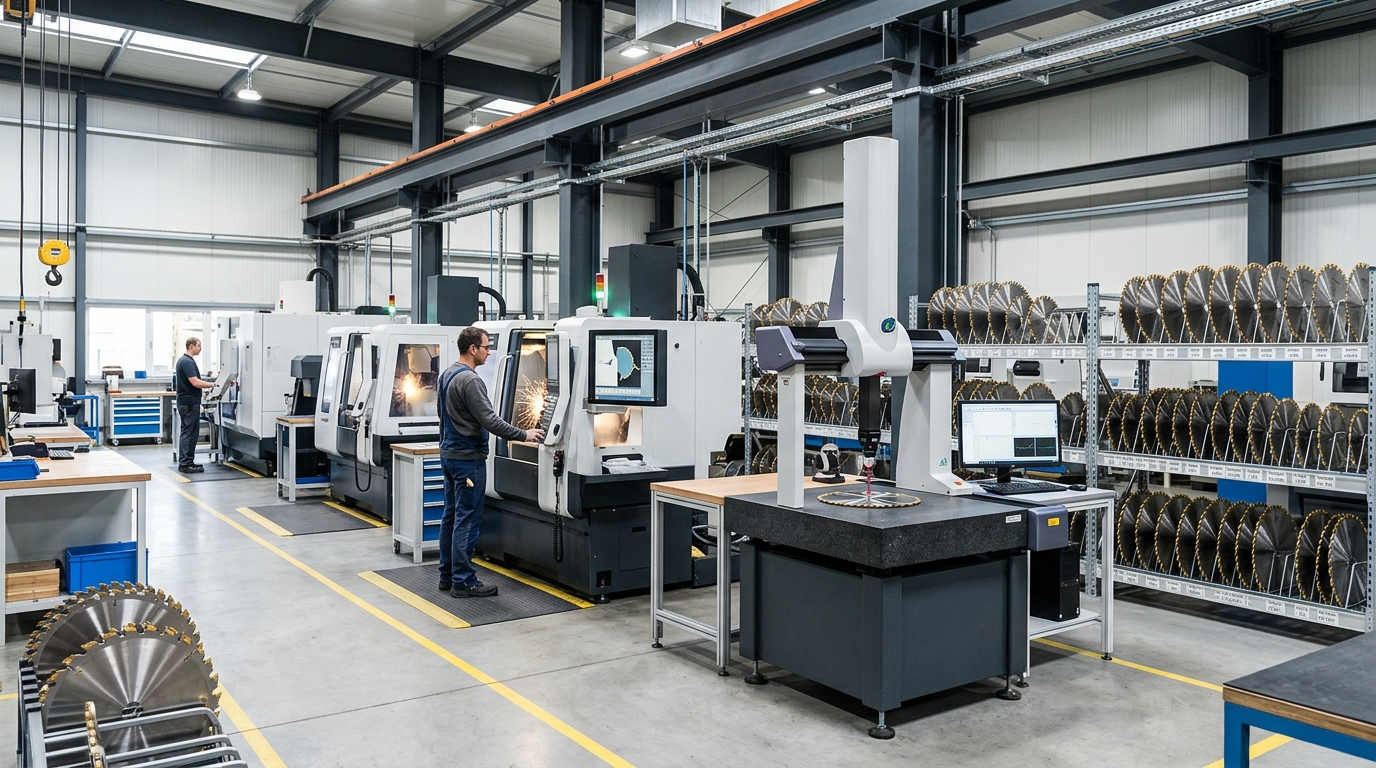
Finally, evaluate the quality team itself. A dedicated QC department with CMM (coordinate measuring machines), dynamic balancing equipment, and documented inspection protocols at each production stage is non-negotiable. Factories that treat quality control as one person’s side job will cost you returns, complaints, and customers.
Top Regions in China for Woodworking Equipment Production
Geography shapes everything — pricing, lead times, raw material quality. Four provinces dominate woodworking tool manufacturing, and each one plays a distinct role in the supply chain.
Zhejiang is the carbide cutting tool heartland. Concentrated around Hangzhou and Jinhua, factories here benefit from deep tungsten carbide supply networks and decades of metallurgical expertise. This is where ZC-TOOLS operates, leveraging Zhejiang’s mature ecosystem to produce industrial-grade saw blades, router bits, and CNC tooling with tight cost control. Port access via Ningbo — China’s second-busiest cargo port according to UNCTAD’s 2023 maritime report — keeps freight competitive for international buyers.
Guangdong leans toward finished woodworking machinery and power tool accessories, driven by proximity to Shenzhen’s electronics supply chain. Costs run 8–15% higher than Zhejiang for comparable cutting tools. Shandong specializes in heavy-duty panel processing equipment, while Jiangsu excels at precision CNC components backed by strong engineering talent from Nanjing and Suzhou universities.
For buyers evaluating a China woodworking tools supplier, location isn’t trivia. A Zhejiang-based manufacturer shipping through Ningbo can shave 3–5 days off delivery to European ports compared to inland alternatives. Raw material proximity matters too — Zhejiang’s direct access to domestic carbide refineries eliminates middlemen that inflate costs elsewhere.

How to Verify Factory Certifications and Quality Control Standards
Certifications can be faked. PDFs get doctored, logos get copied, and a slick website means nothing without verification. Before committing to any China woodworking tools supplier, treat their credentials like a financial audit — trust the process, not the claim.
Start with ISO and Product Compliance
Ask for the supplier’s ISO 9001 certificate and cross-check the certificate number directly on the issuing body’s website. A legitimate ISO 9001:2015 certification means the factory follows documented quality management procedures — not just that they paid for a plaque on the wall. For tools entering European markets, CE marking is mandatory; for North America, look for ANSI B7.1 compliance on abrasive tools or specific UL listings on powered equipment. ZC-TOOLS, for example, maintains both CE and ISO documentation that buyers can verify independently, which sets a useful benchmark when comparing other factories.
Use Third-Party Audits — Don’t Skip This
Platforms like SGS and Bureau Veritas offer factory audit services ranging from $800 to $2,500 depending on scope. Request a BSCI or SMETA audit report if the supplier already has one — reputable factories keep these on file. If they hesitate or claim audits are “unnecessary,” walk away. A pre-shipment inspection (PSI) covering dimensional accuracy, hardness testing (Rockwell HRC checks on carbide tips), and packaging integrity costs roughly $300 per batch and catches defects before they reach your warehouse.
Sample Testing Protocol
Order 5–10 sample units across different SKUs. Run them hard. For saw blades or router bits, that means testing cut quality, heat dissipation, and edge retention across at least 200 linear meters of material — our industrial cutting tools buyer’s guide outlines specific performance metrics to measure. Compare sample quality against the first bulk shipment; consistency between the two tells you more about real QC discipline than any certificate ever will.

Understanding Minimum Order Quantities, Pricing, and Shipping Costs
MOQs vary wildly. A China woodworking tools supplier producing TCT saw blades might set minimums at 500 pieces per specification, while diamond-tipped router bits could start at just 100 units due to higher per-unit costs. Factories like ZC-TOOLS often offer flexible MOQs for first-time buyers — sometimes as low as 200 pieces — to let you test quality before committing to larger volumes.
Pricing structure matters more than the unit price itself. FOB (Free on Board) means you handle freight from the Chinese port; CIF (Cost, Insurance, Freight) bundles shipping into the quote. FOB gives you more control over logistics costs, especially if you already have a freight forwarder. CIF looks simpler but often hides markup. Always request both quotes and compare.
Container optimization cuts landed costs fast. A 20ft container holds roughly 28 cubic meters. Mixing SKUs — say, saw blades alongside router bits and planer knives — fills dead space and drops your per-unit shipping cost significantly. For smaller orders, LCL (Less than Container Load) works, though expect $150–$300 in port handling surcharges.
Payment terms deserve negotiation. Most suppliers default to 30% T/T deposit with 70% before shipment. After two or three successful orders, push for 30/70 with the balance payable against copy of Bill of Lading. Letters of Credit (L/C) offer stronger protection on orders above $20,000 but add bank fees of 1–2%. According to the International Trade Administration, understanding Incoterms is critical to avoiding hidden cost surprises in cross-border transactions.
Red Flags to Avoid When Sourcing Wholesale Woodworking Tools
Cheap quotes catch attention. They also catch buyers off guard when shipments arrive with chipped carbide tips, warped blade bodies, or packaging that doesn’t match the samples. Knowing what to watch for before you wire payment separates a profitable sourcing decision from an expensive lesson.
Inconsistent or Stolen Product Photos
Reverse-image search every product photo a supplier sends you. If the same saw blade image appears on six different Alibaba storefronts, that’s not a factory — it’s a trading company scraping photos. Legitimate manufacturers like ZC-TOOLS shoot their own product images, often with factory backgrounds, batch numbers visible, and consistent lighting across the catalog. A supplier who can’t provide a 30-second video of your specific product on their production line is hiding something.
Refusal to Allow Factory Visits or Live Video Walkthroughs
COVID normalized remote audits. No excuse remains for refusing a live video call showing the shop floor. If a China woodworking tools supplier dodges this request — citing “policy,” “renovation,” or “busy season” three times in a row — walk away. Real factories welcome scrutiny because it closes deals faster.
Quotes That Undercut the Market by 30%+
Tungsten carbide has a global spot price. Steel substrates have a floor cost. When a quote comes in dramatically below competitors, the math only works if they’re substituting cheaper YG6 carbide for YG8, thinning the blade body below spec, or skipping heat treatment steps. The raw material cost alone for a quality TCT blade makes certain price points physically impossible.
Vague Contract Terms and Missing Warranty Language
A trustworthy supplier spells out defect tolerance rates (typically 0.3–0.5%), replacement or refund procedures, and inspection standards — referencing specific norms like DIN or GB/T. Contracts that say “quality guaranteed” without defining what that means give you zero leverage in a dispute. Ask for the quality clause in writing before the first order, not after a container of industrial woodworking cutting tools arrives with problems.
What Transparent Suppliers Do Differently
- Provide traceable batch records linking each order to raw material certificates
- Share third-party test reports proactively, not only when asked
- Offer pre-shipment inspection windows of 48–72 hours
- Maintain consistent pricing structures with clear breakdowns for tooling, materials, and freight
ZC-TOOLS, for instance, assigns a dedicated account manager who shares real-time production photos at each milestone — blanking, brazing, grinding, balancing, and final packaging. That level of visibility doesn’t just reduce risk. It eliminates the guesswork that makes international sourcing stressful.
Frequently Asked Questions About Sourcing Woodworking Tools from China
How do I find suppliers beyond Alibaba?
Trade shows like Canton Fair and CIFM remain the fastest way to meet manufacturers face-to-face. Industry directories from HKTDC also list verified exporters. Specialist brands such as ZC-TOOLS maintain their own websites with full product catalogs, so you can request quotes directly — skipping platform fees entirely.
Can I visit the factory before ordering?
Yes, and you should. Most established factories welcome buyer visits with 2–3 weeks’ advance notice. ZC-TOOLS, for example, arranges guided production-line tours so buyers can inspect CNC grinding stations, coating processes, and finished-goods warehouses firsthand.
What is the typical lead time?
Standard catalog items ship in 15–25 days. Custom tooling — special tooth profiles, non-standard diameters — usually takes 30–45 days depending on complexity. Always confirm lead times after deposit, not before.
Does ZC-TOOLS support small trial orders?
They do. Trial orders as low as 50–100 pieces per SKU are accepted for first-time buyers evaluating quality. This lets you test performance in your own workshop before committing to bulk volumes. Check their industrial cutting tools buyer’s guide for detailed specs before sampling.
How do I handle customs and import duties?
Your China woodworking tools supplier typically ships EXW or FOB. From there, a freight forwarder handles sea or air transport. Import duties depend on your country’s HS code classification — carbide-tipped saw blades, for instance, fall under different tariff rates than solid-steel planer knives. Hire a licensed customs broker for your first shipment; the $150–$300 fee prevents costly classification errors.
Your Next Steps to Partner with a Trusted China Woodworking Tools Supplier
You’ve done the research. Now act on it. Here’s a quick-reference checklist to keep your sourcing process sharp:
- Shortlist 3–5 suppliers with verified ISO 9001 certifications and at least 8 years of export history.
- Request physical samples — not just product photos — before committing to any bulk order.
- Confirm MOQs, unit pricing at your target volume, and FOB vs. CIF shipping breakdowns in writing.
- Schedule a factory visit or live video walkthrough of the production floor and QC stations.
- Cross-check supplier claims against Made-in-China.com audit reports or third-party inspection records.
- Review the industrial woodworking cutting tools buyer’s guide to match tool specifications with your exact application needs.
One supplier worth putting at the top of that shortlist is ZC-TOOLS. As a China woodworking tools supplier with its own manufacturing base, ZC-TOOLS offers TCT saw blades, router bits, diamond tooling, and PCD cutters — all produced under documented quality control protocols. They work with distributors across Europe, Southeast Asia, and the Americas, so export logistics aren’t an afterthought.
Ready to move? Visit zc-tools.com to download product catalogs, arrange a factory tour, or request a no-obligation quotation. A single email can cut months off your sourcing timeline — send it today.